UK Garage Drum Patterns: How to Get That 2-Step Swing
A UK garage drum pattern gets its skip from two things: a kick that leaves out beat three, and 16th-note hats with heavy swing. Add a snare on two and four, a few ghost notes, and a tempo of 130 to 135 BPM, and you're there.
I'm a UK producer, and garage was one of the first styles I tried to copy. It took me a while to work out why my early attempts sounded like stiff house. These five patterns, and the swing settings under them, are what fixed it. Each one comes with a step grid and a free MIDI file.
What is a UK garage beat?
A UK garage beat is a swung, shuffling drum groove at 130 to 135 BPM. In 2-step, the most famous style, the kick drops beat three and moves to a syncopated spot, so the bar feels like it skips.
Why the kick skips
House has four kicks in every bar. Classic 2-step has two: one on beat one and one on the "and" of beat three, which is step 11 on a 16-step grid. That gap where a house producer expects a kick is what makes the groove lurch forward.
The 16th-note shuffle
Garage hats run on 16th notes, and every second 16th is pushed late with swing. Garage usually swings harder than house, often 58 to 66 percent. The snare stays mostly on two and four, with quiet ghost snares around it to add bounce.
How to read the grids
Each grid is one bar of 16 steps. The shaded columns are the four beats, on steps 1, 5, 9 and 13.
- A tall orange block is a full hit, at velocity 108 to 118.
- A short, darker block is a soft ghost note, at velocity 56.
- An empty cell is a rest.
The MIDI files are written straight, with no swing baked in, so you can set the swing yourself in Ableton's Groove Pool. They use General MIDI drum notes: kick on C1, snare on D1, clap on D#1, closed hat on F#1 and open hat on A#1.
Each file is four bars long, with a download link under its grid. Swing is what makes garage, so you'll want to hear these with it on. Drag a file onto a Drum Rack and add swing with the Groove Pool steps further down. Or, if you have DRUM//GEN, drop it onto the device and it'll play the pattern through your kit and grow new variations from it.
5 UK garage drum patterns
Start with classic 2-step. The other four show how far the same ideas stretch, from four-to-the-floor speed garage to the heavier swing of newer UKG.
1. Classic 2-step drum pattern
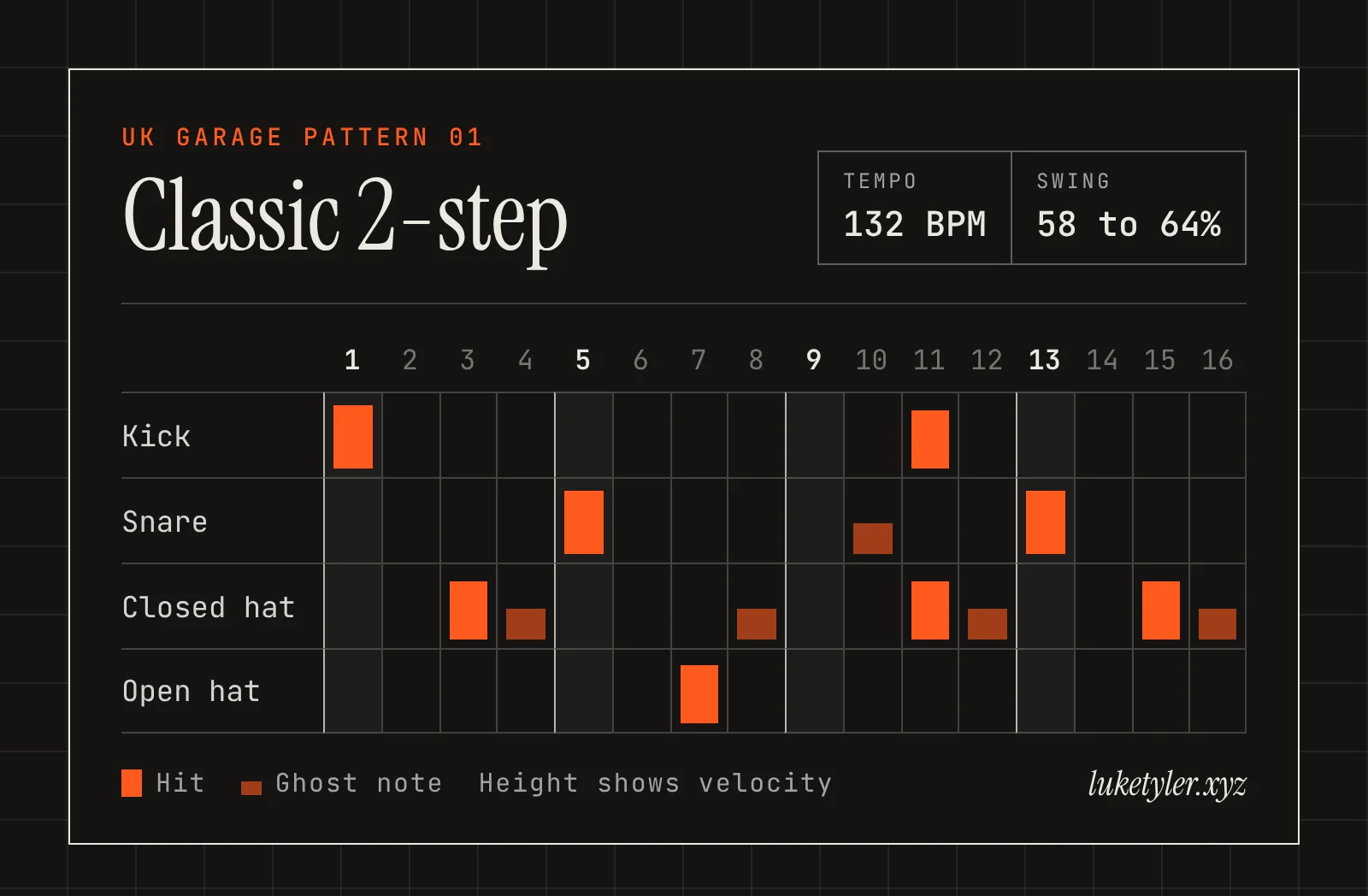
This is the core UK garage drum pattern. The kick plays on step 1, then skips beat three and lands on step 11 instead. The snare stays on two and four. Swung ghost hats after each off-beat give it the shuffle, and a single open hat on step 7 lifts the middle of the bar.
Tempo: 130 to 134 BPM (the MIDI is at 132). Swing: 58 to 64 percent on 16ths.
Try this: in bar two, add a kick on step 8. It's a common 2-step variation that makes the second half of the phrase push harder.
2. Speed garage drum pattern
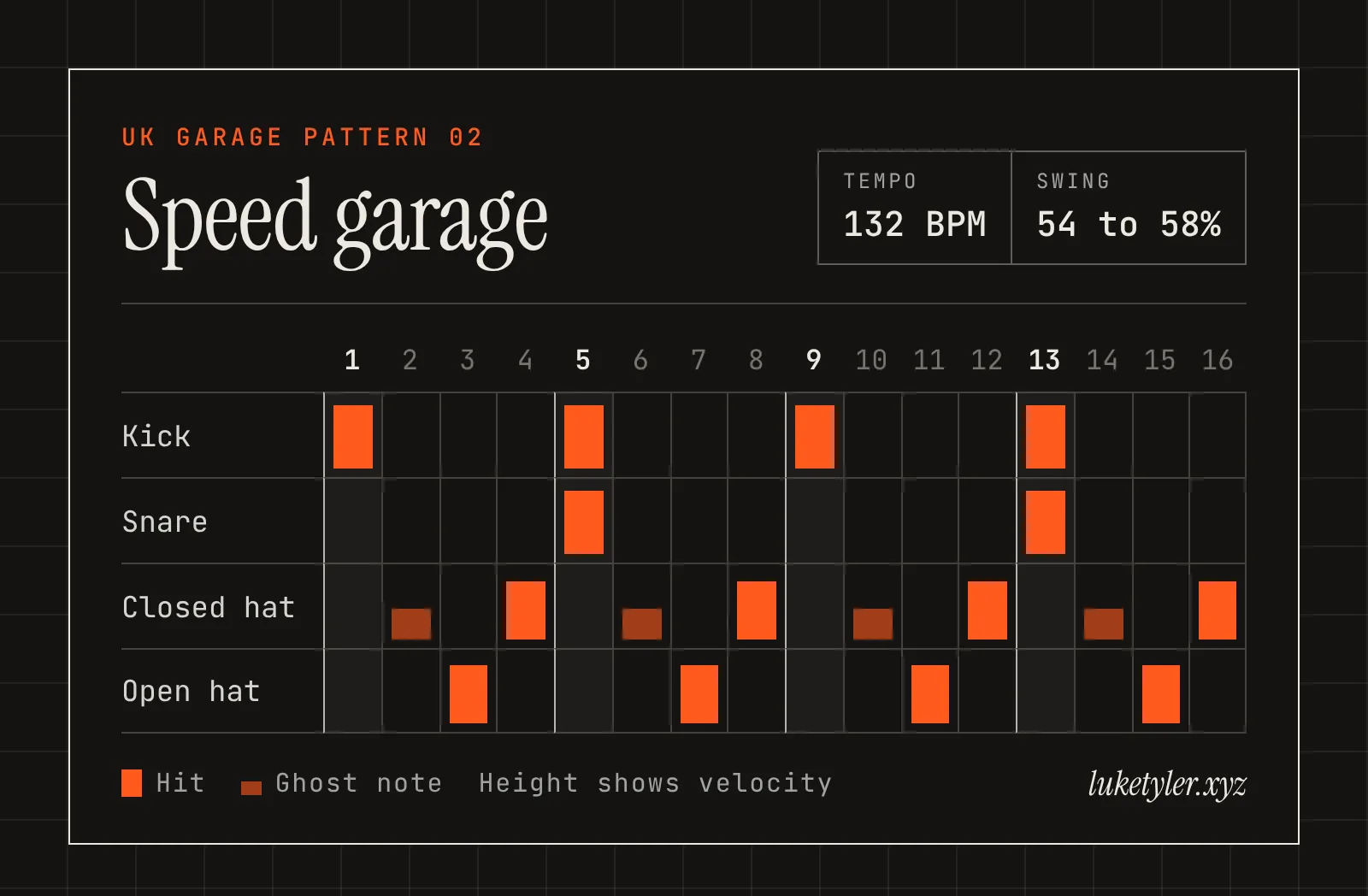
Speed garage keeps a four-to-the-floor kick and puts a big open hat on every off-beat. The closed hats fill the 16ths in between, with the accent on the last 16th of each beat. Less swing here, because the bassline usually brings the bounce.
Tempo: 130 to 135 BPM (the MIDI is at 132). Swing: 54 to 58 percent on 16ths.
Try this: give the open hat a slightly longer decay than you'd use in house. That loose, splashy hat is a big part of the sound.
3. Bassline drum pattern
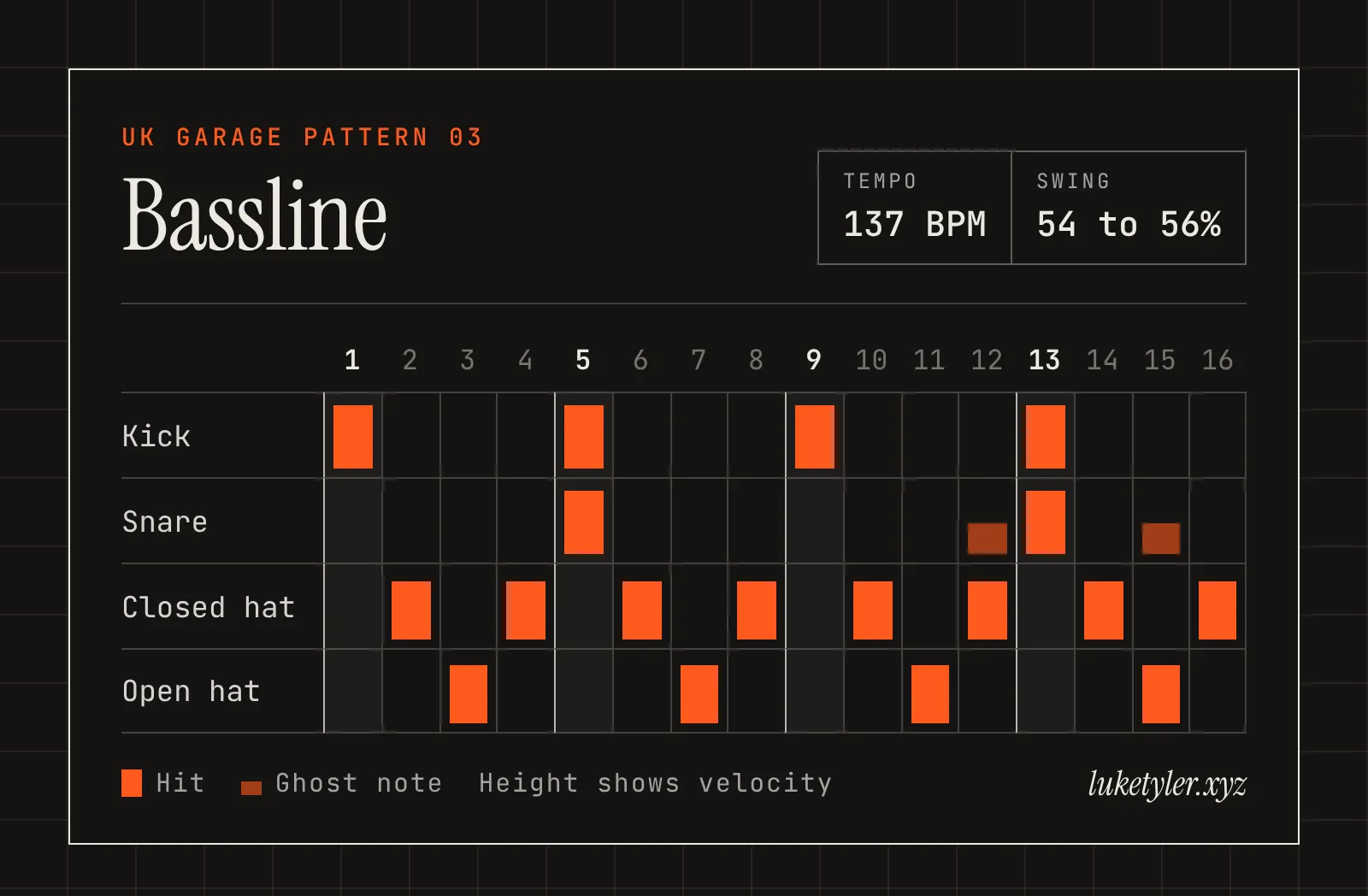
Bassline is a quicker, harder cousin of speed garage, usually a touch faster than the 130 to 135 BPM most UK garage sits at. The drums are simple and busy: four kicks, off-beat open hats and closed hats on every other 16th. Two ghost snares near the end of the bar keep it rolling.
Tempo: 135 to 140 BPM (the MIDI is at 137). Swing: 54 to 56 percent on 16ths.
Try this: sidechain the bass to the kick hard. In bassline the drums and bass work as one pumping part, so leave room for the bass in the low mids.
4. Modern UKG drum pattern
Newer UK garage keeps the 2-step skeleton but swings harder and adds more off-grid kicks. Here the kick lands on 1, 8 and 11, with a ghost on 15 rolling into the next bar. Two ghost snares sit around the main ones.
Tempo: 132 to 134 BPM (the MIDI is at 133). Swing: 62 to 66 percent on 16ths.
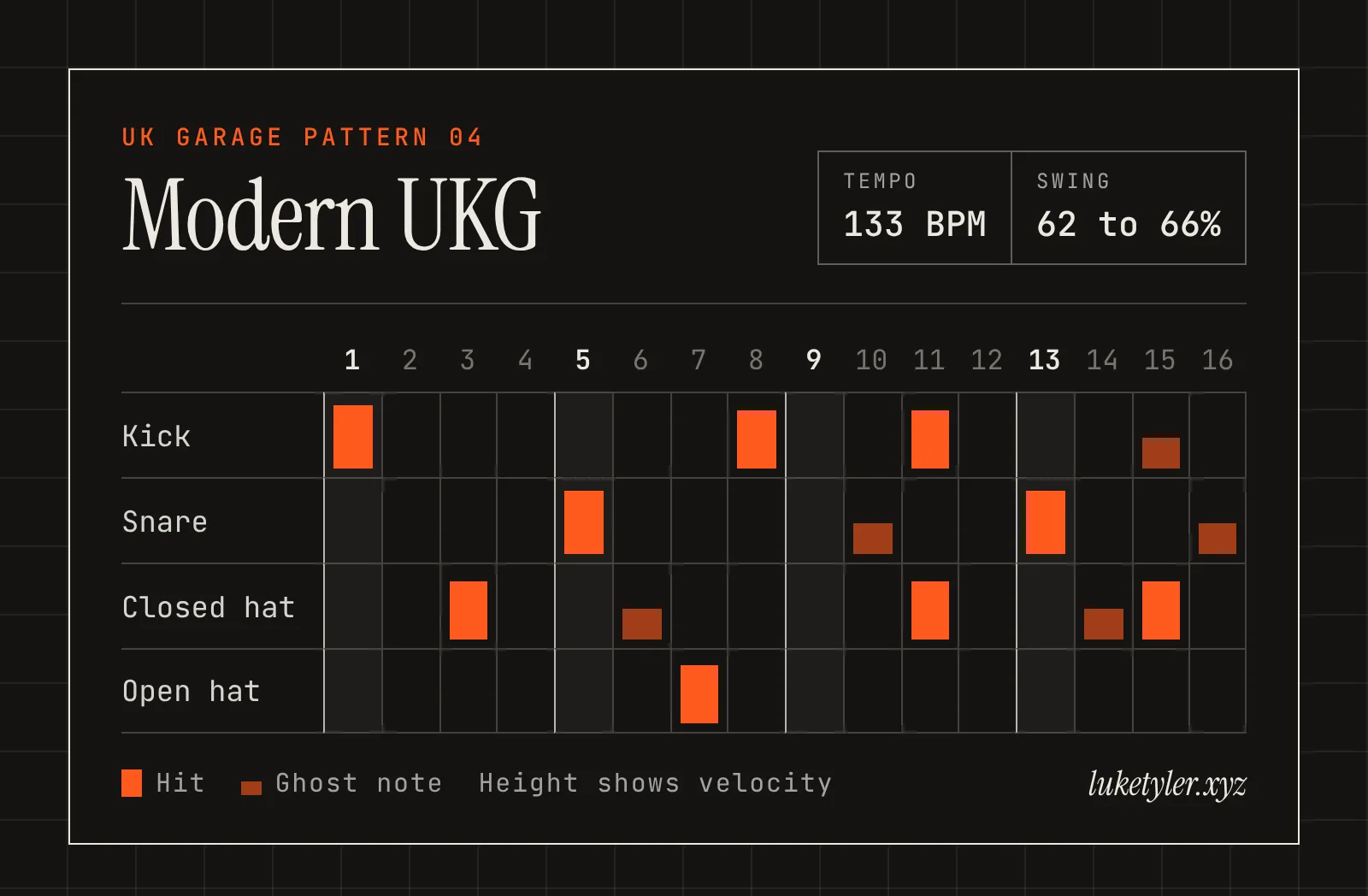
Try this: add a short percussion loop, such as a shaker or bongo, with the same groove applied. Modern UKG often gets its movement from percussion more than from the hats.
5. Garage house drum pattern
Garage house sits between house and UK garage. The kick stays four to the floor, but the hats swing like garage, with soft ghost notes on every even step. The open hat lands on two of the four off-beats.
Tempo: 128 to 132 BPM (the MIDI is at 130). Swing: 60 to 62 percent on 16ths.
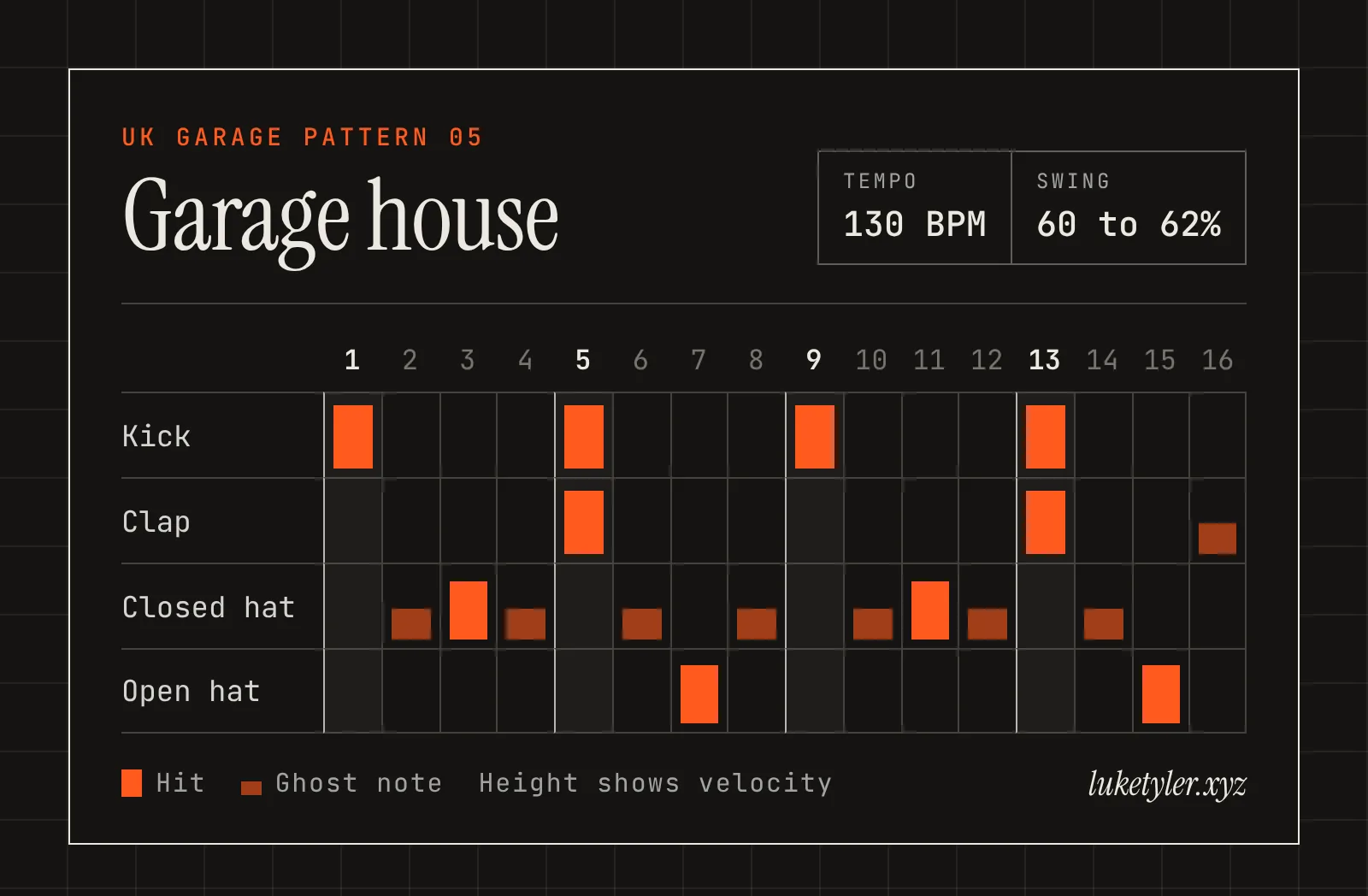
Try this: write the hats in this pattern, then switch the kick to the classic 2-step pattern for the breakdown. You get a lift without changing tempo.
How to get the swing right in Ableton's Groove Pool
Apply a 16th-note swing groove to the clip, then set its Timing to 100 percent and Base to 1/16. Use the Global Amount to dial it in by ear.
- Open the Browser and go to Grooves. In the Swing folder you'll find 16th-note grooves named by amount, such as Swing 16-55. Pick the one closest to the swing I've given for the pattern.
- Drag the groove onto your drum clip. It also appears in the Groove Pool, which you can open with the wavy-lines button at the bottom of the Browser.
- In the Groove Pool, check that Base is set to 1/16. Set Timing to 100 percent to start with, and leave Quantize, Random and Velocity at 0.
- Play the loop and adjust the Global Amount at the top of the Groove Pool. Lower it for less swing, push it past 100 percent for more.
- When you're happy, click Commit in the clip's groove settings. That writes the swing into the notes, so you can then nudge single hits by hand.
A good trick is to use two grooves. Put the hats on their own clip or chain with a heavier swing, and keep the kick and snare a little straighter. The tension between them is where a lot of the garage feel comes from.
Mistakes that kill the bounce
Most flat garage beats come down to the same few problems: too little swing, every hit at full velocity, or a kick on every beat. Fix those and the groove usually opens up.
- Swinging nothing. Straight 16ths at 132 BPM sound like fast house. Garage needs real swing on the hats.
- Swinging everything the same. If the kick, snare, hats and bass all share one heavy groove, it can feel drunk. Try more swing on the hats than on the kick.
- Flat velocity. Ghost hats and ghost snares should be clearly quieter than the main hits. Without that, the shuffle turns into noise.
- Too many kicks. If you're writing 2-step, resist putting a kick back on beat three. The gap is the point.
- Long, boomy kicks. A kick with a long tail fights the bass. Keep it short and punchy so the bassline has room.
Generate garage-style patterns with DRUM//GEN
If you'd rather start from a fresh groove each time, DRUM//GEN, my drum pattern generator for Ableton, has a Garage feel built in. Pick it, hit Generate, and it writes a 4-bar pattern straight into a clip with its own swing and velocity range.
It maps your Drum Rack for you, builds variations from the same root so your A and B sections belong together, and puts fills in their own clips. You can also drop one of the MIDI files from this post onto it and grow new variations from there. It's £15 in the Max for Live devices shop.
Hear it in finished tracks
To hear these grooves in context, listen to the garage tracks in my publishing catalogue. Here are a few of them.
If you're coming at garage from the four-to-the-floor side, my post on house drum patterns has eight grooves that pair well with this one, including a garage-tinged house pattern.
FAQs
What BPM is UK garage?
Most UK garage sits between 130 and 135 BPM, with 132 to 134 a very common choice. Garage house can drop to around 128. Bassline, a related style, often runs faster, at 135 to 140.
How is 2-step different from house?
House has a kick on every beat. 2-step drops some of those kicks, usually keeping beat one and moving another to a syncopated spot like step 11. It's also faster and swings harder, which gives it that skipping feel.
How much swing does UK garage use?
Usually 58 to 66 percent on 16th notes, which is more than most house. Speed garage and bassline swing less, often 54 to 58 percent. Start around 60 and adjust until the hats feel like they're bouncing.
What drum samples suit UKG?
Short, crisp sounds work best. Look for a punchy kick with a quick tail, a snappy snare or rim, and bright, tight hats. Shakers and small percussion help too, as long as they're kept short.
Is speed garage the same as UK garage?
Speed garage is a style of UK garage. It came up in the mid to late 1990s and kept a four-to-the-floor kick, with big off-beat open hats and heavy basslines. 2-step, with its skipping kick, became popular a little later.