House Drum Patterns: 8 Grooves You Can Steal (With Free MIDI)
A house drum pattern starts with a kick on every beat, a clap on beats two and four, and a hat on the off-beat in between. That's the skeleton. The feel comes from swing, velocity and one or two hits in the right place.
I've been making house for years, and these are eight patterns I keep coming back to. Each one has a 16-step grid and a free MIDI file you can drop into Ableton or any other DAW. Steal them, bend them and make them yours.
What makes a drum pattern sound like house?
Four things: a steady kick at 120 to 128 BPM, a clap or snare on two and four, an off-beat hat, and a little swing. Get those right and almost any sounds will feel like house.
The kick
House is built on four to the floor. That means a kick on every quarter note, so four kicks in every bar. It's the thing dancers lock on to, so it should be steady and solid. Most of the time you won't want ghost kicks or clever placement. Save those for fills.
The clap or snare
The clap sits on beats two and four, which are steps 5 and 13 on a 16-step grid. Many producers layer a clap with a snare or a rim, then nudge one of them a few milliseconds late to make it wider.
The off-beat hat
The hat between each kick is the most important sound in house after the kick itself. It lands on steps 3, 7, 11 and 15, the "and" of each beat. An open hat there gives you the classic lift. A closed hat feels tighter and deeper.
Swing and velocity
Swing delays every second 16th note by a small amount. At 50 percent it's dead straight. House usually sits between 54 and 62 percent, and deep house tends to swing more than tech house. Velocity matters just as much. If every hit is at full volume, the pattern will sound stiff no matter how good the sounds are.
How to read the grids
Each grid below is one bar of 16 steps, and each step is a 16th note. The shaded columns are the four beats, on steps 1, 5, 9 and 13.
- A tall orange block is a full hit, at velocity 108 to 118.
- A short, darker block is a soft ghost note, at velocity 56.
- An empty cell is a rest.
The MIDI files are written straight, with no swing baked in, so you can set it yourself in Ableton's Groove Pool. They use General MIDI drum notes (kick C1, rim C#1, clap D#1, closed hat F#1, open hat A#1), which line up with most Drum Rack kits. The tempo and swing are suggestions. Trust your ears.
Each file is four bars long, and there's a download link under every grid. The quickest way to hear one is to drag it onto a Drum Rack in Ableton. If you have DRUM//GEN, drop the file onto it instead, and you'll hear the groove through your own kit with fresh variations built from it.
8 house drum patterns to steal
These go roughly from classic to more unusual. Start with the first one if you're new to programming house drums, then work down the list.
1. Chicago house drum pattern
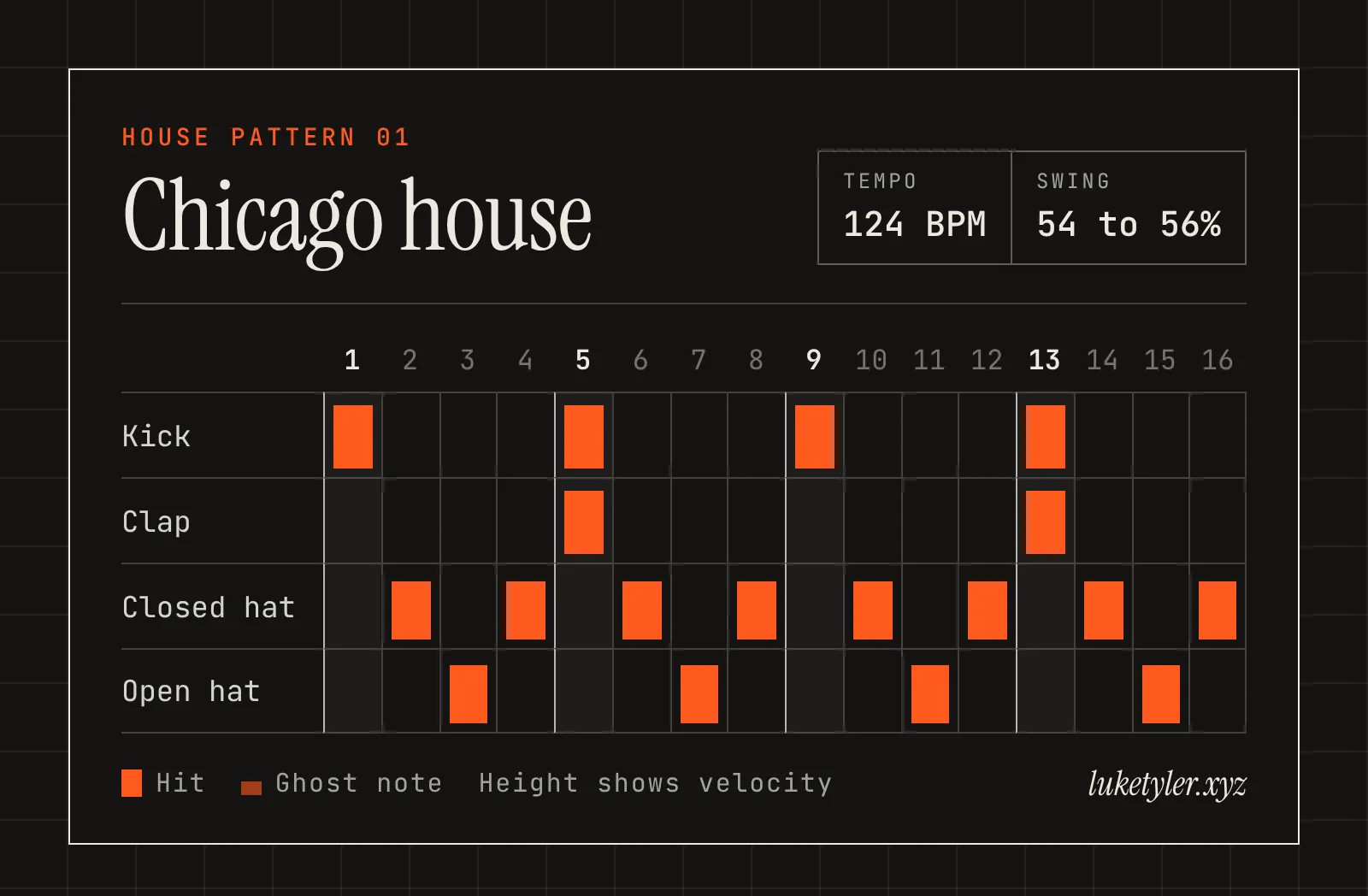
This is the one most people picture when they hear the words house drum pattern. Kick on every beat, clap on two and four, an open hat on every off-beat, and closed hats filling the gaps. It gallops. Keep the closed hats a touch quieter than the open ones so the off-beat still leads.
Tempo: 122 to 126 BPM (the MIDI is at 124). Swing: 54 to 56 percent on 16ths.
Try this: drop the clap on beat four of every fourth bar and let the hats carry it. It gives the loop a small breath before it comes round again.
2. Deep house drum pattern
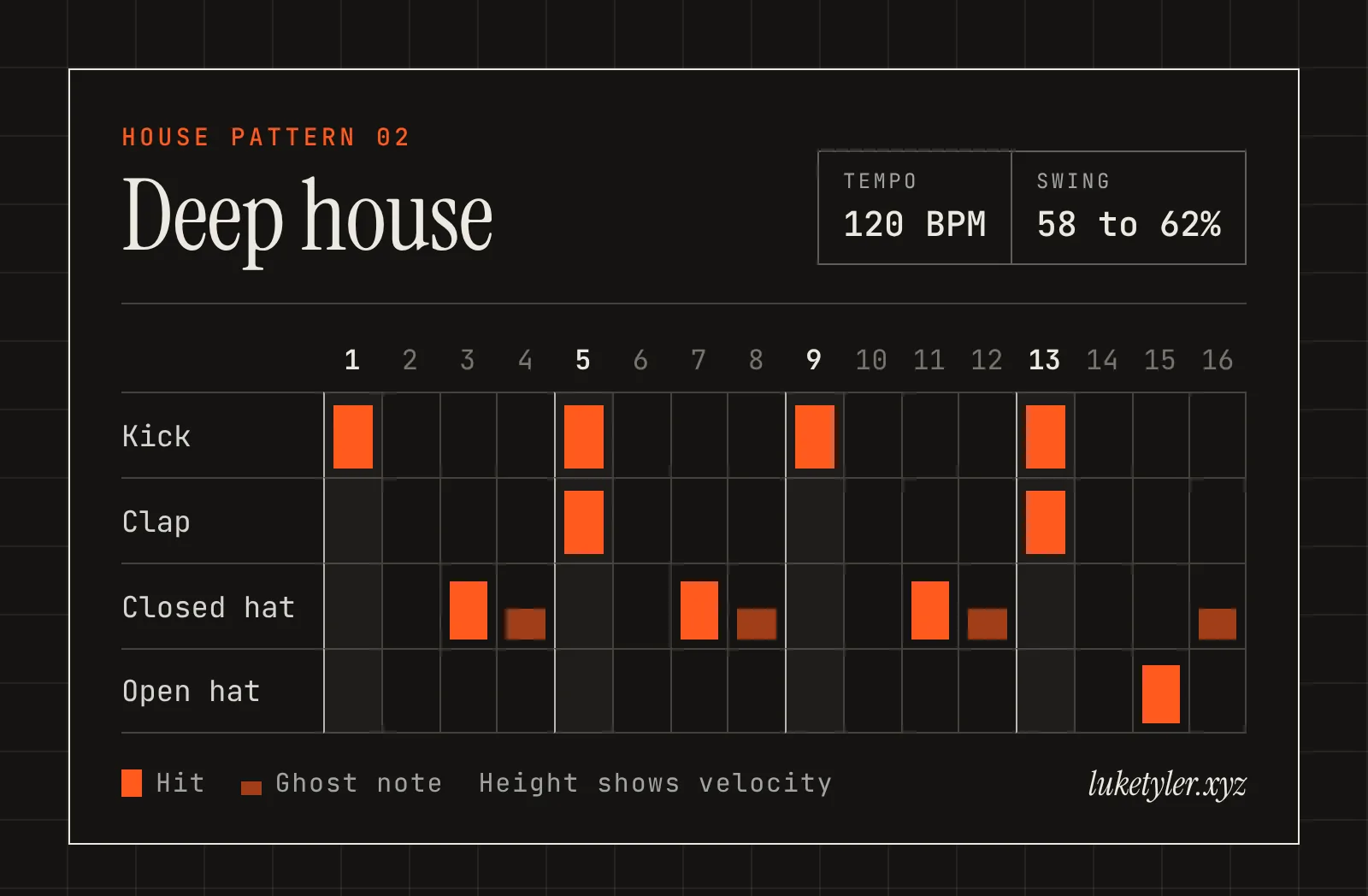
Deep house drums are softer and rounder. The off-beat closed hat does most of the work, and a quiet ghost hat straight after each one adds a lazy shuffle. One open hat at the end of the bar lifts it into the next.
Tempo: 118 to 122 BPM (the MIDI is at 120). Swing: 58 to 62 percent on 16ths.
Try this: swap the clap for a rim shot or a finger snap, and pull the kick back a few dB. Deep house sits under the chords, so the drums should feel like they're leaning back.
3. Tech house drum pattern
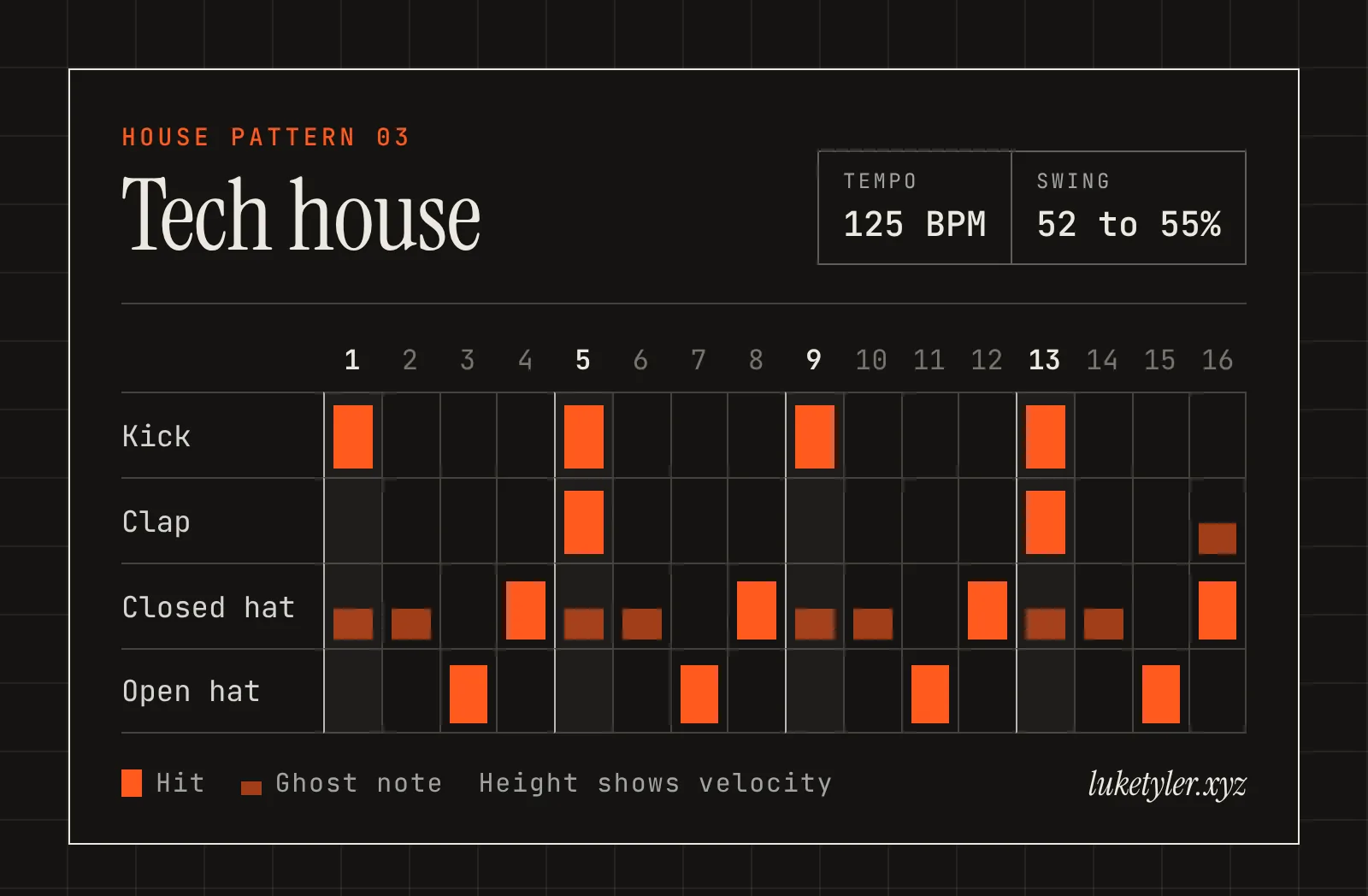
A tech house drum pattern is tighter and more driving. Closed hats run on every 16th that the open hat doesn't take, with accents on the last 16th of each beat. A soft ghost clap on step 16 pushes into the next bar.
Tempo: 124 to 127 BPM (the MIDI is at 125). Swing: 52 to 55 percent on 16ths.
Try this: keep the swing low and let velocity make the groove instead. Tech house works best when the hats feel almost mechanical and the bass does the bouncing.
4. Minimal house drum pattern
A minimal house drum pattern leaves space on purpose. Here the off-beat swaps between a closed hat and an open one, so the bar has a short and long feel. One quiet ghost clap on step 10 is all the extra movement it needs.
Tempo: 123 to 126 BPM (the MIDI is at 124). Swing: 56 to 58 percent on 16ths.
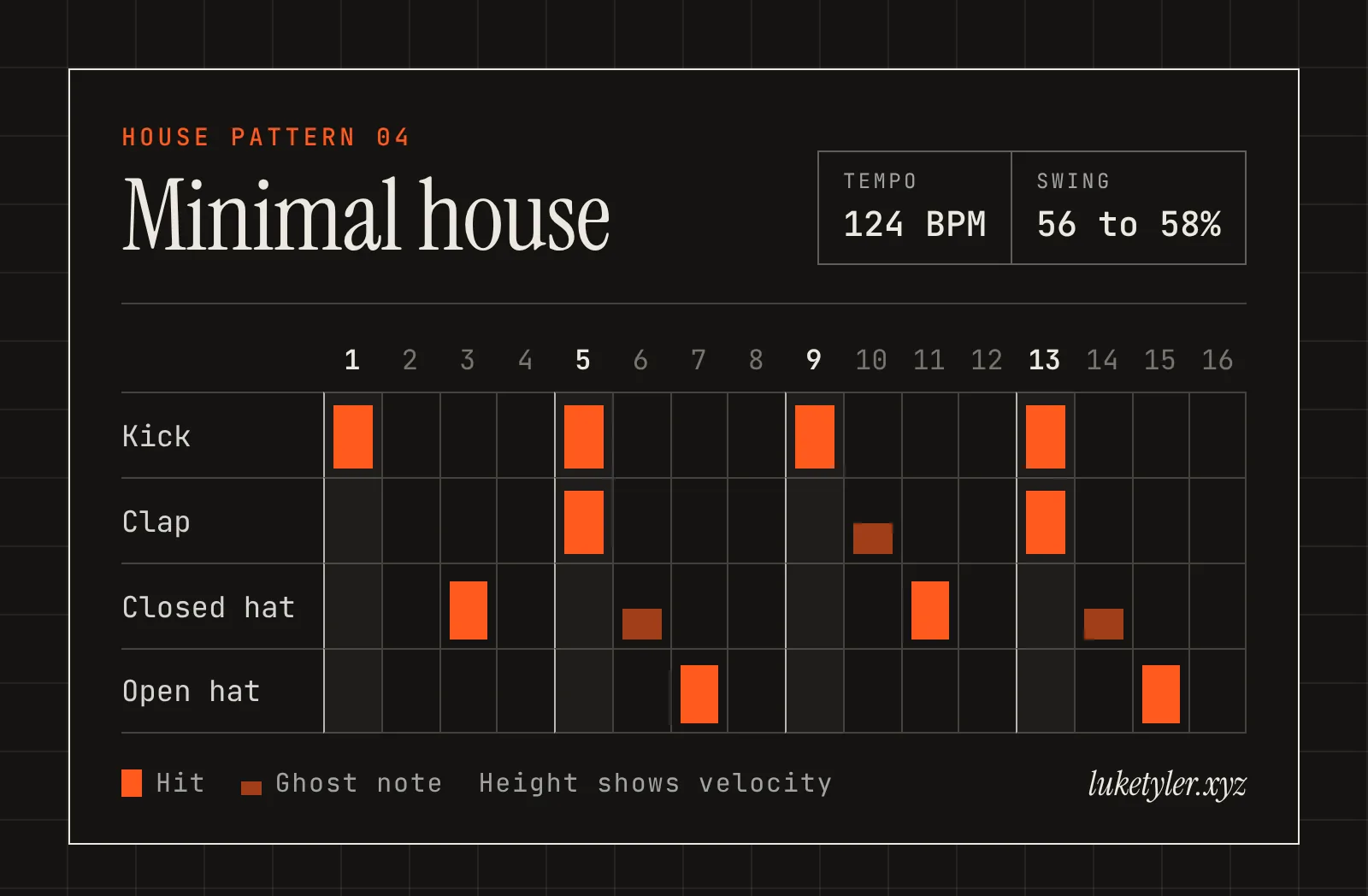
Try this: use very short, clicky sounds and automate the open hat's decay over 16 bars. In minimal, small changes over time matter more than busy patterns.
5. Garage-tinged house drum pattern
This one keeps the four-to-the-floor kick but borrows the shuffle from UK garage. The swing is heavier, there's a ghost kick on step 11, and soft claps on steps 8 and 16 make the bar skip. The open hat moves to the very last step.
Tempo: 124 to 128 BPM (the MIDI is at 126). Swing: 60 to 64 percent on 16ths.
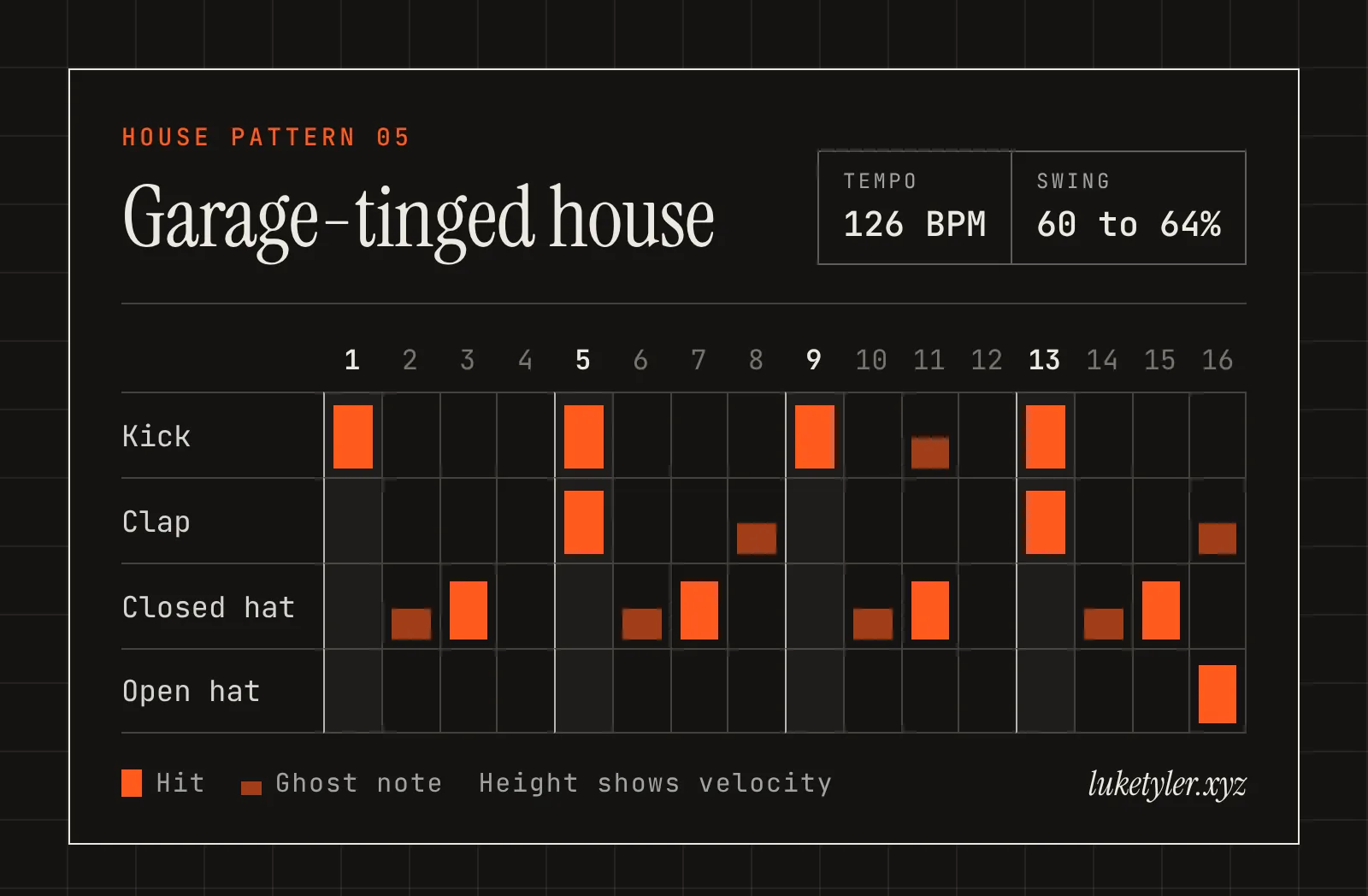
Try this: push the swing up to 64 percent on the hats only, and leave the kick and clap straight. That split is where the bounce comes from.
6. Disco house drum pattern
Disco house drums are nearly straight. A long, splashy open hat on every off-beat gives you that classic tss sound, and a short closed hat on the beat cuts it off. Put both hats in the same choke group so each one stops the other.
Tempo: 120 to 124 BPM (the MIDI is at 122). Swing: 50 to 53 percent on 16ths.
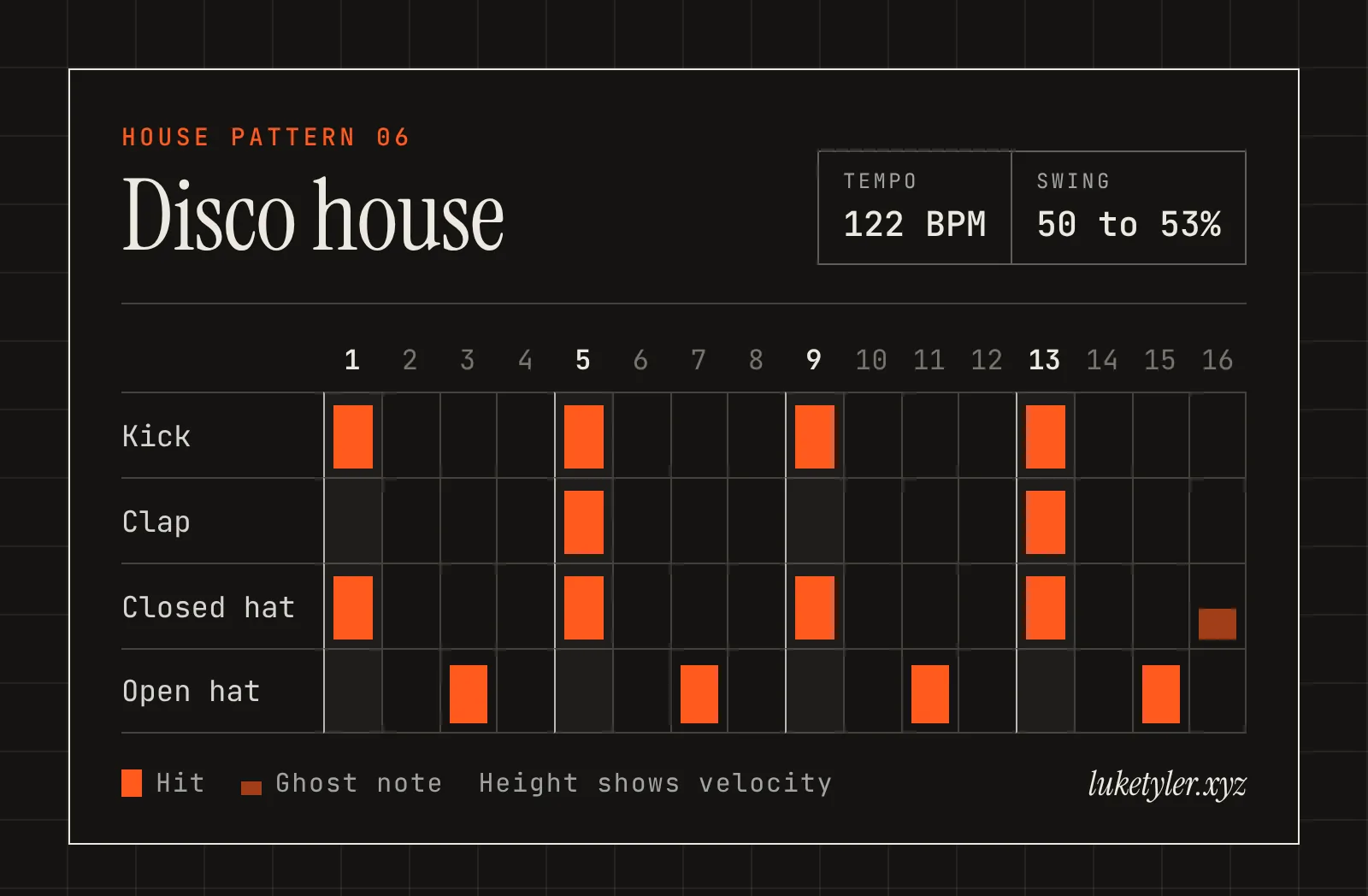
Try this: add a tambourine on every 8th, or layer a live-sounding snare under the clap. Disco grooves love a bit of real air.
7. Afro-leaning house drum pattern
Here a rim plays a 3-2 clave instead of a clap on two and four: steps 1, 4, 7, 11 and 13. It's written on the rim note (C#1), so a rim, a clave or a short wood sound will all work. The kick stays steady, so the pattern feels rooted while the clave pulls across the bar.
Tempo: 120 to 124 BPM (the MIDI is at 122). Swing: 57 to 60 percent on 16ths.
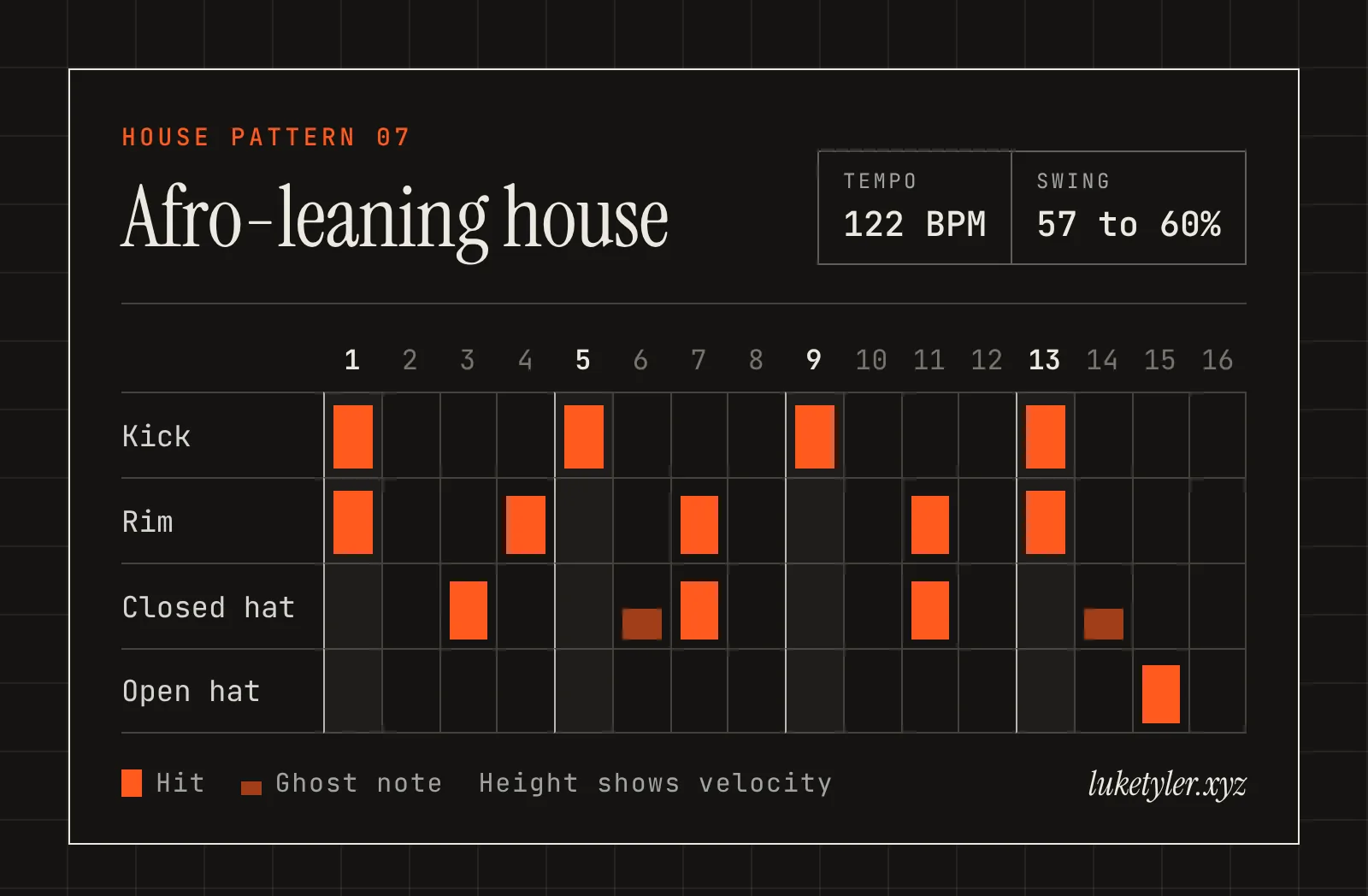
Try this: add congas or a low tom on the off-beats of bar two only. Afro house grooves often build by adding percussion layers rather than changing the main pattern.
8. Broken house drum pattern
This one breaks the four-to-the-floor rule. The kick lands on step 1, then on 7 and 11, with a ghost on 14. The clap stays on two and four to hold it together. It works well for breakdowns, B sections or when a track needs a change of gear.
Tempo: 122 to 126 BPM (the MIDI is at 124). Swing: 56 to 58 percent on 16ths.
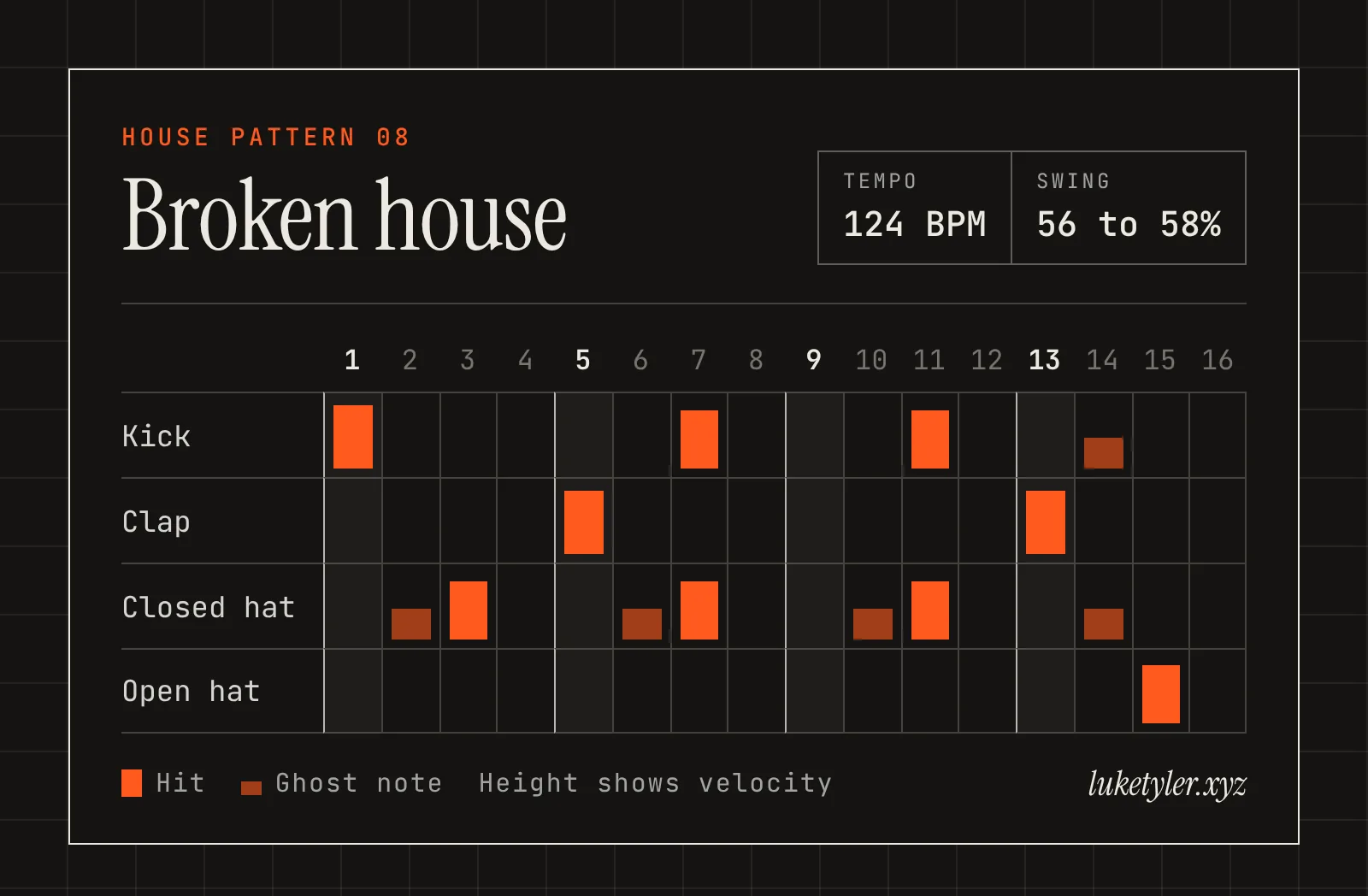
Try this: play the Chicago pattern for 12 bars and this one for 4. The switch feels like a fill without needing one.
How to make these patterns your own
Change one thing at a time. Move a single hit, add a ghost note or swap one sound, then listen for 16 bars before you change anything else.
Move one hit
Pick a single closed hat and move it one step later. Or shift the open hat on step 15 to step 16. Tiny moves like these give a pattern its own fingerprint, and they're easy to undo.
Add ghost notes
Quiet notes between the main hits are where groove lives. Try a soft snare on step 8 or step 16, or a very quiet kick on step 15 to roll into the next bar. If you can clearly hear a ghost note, it's probably too loud.
Layer sounds
Two claps panned slightly apart, or a clap with a snare under it, will sound fuller than one. A shaker playing straight 16ths under a swung hat adds a nice push and pull. Keep layers short so they don't smear the groove.
Write a 4-bar phrase
One bar on loop gets dull fast. Keep bars one and three the same, then change one or two hits in bars two and four. That small call and answer makes a loop feel like a part of a track.
Quicker: generate house patterns with DRUM//GEN
If you want fresh patterns without programming every step, I built a tool for that. DRUM//GEN, my Max for Live drum pattern generator, writes a full 4-bar groove straight into a clip in Ableton. Pick the 4x4 feel for house, hit Generate, and it plays through your own Drum Rack.
It reads your pad names and maps the kick, snare and hats for you. You can add variations to build Scene A, B and C from the same root, and fills land in their own clips. You can also drop one of the MIDI files from this post onto it, and it'll grow new variations from that groove.
It's £15, and you can see it with my other tools in the Max for Live devices shop. If you're looking for more devices, I've also put together a guide to the best Max for Live devices, sorted by what they do.
Hear these grooves in finished tracks
Patterns only tell half the story. To hear how these drums sit with bass, chords and arrangement, have a listen to the house tracks in my publishing catalogue. Every clip is 30 seconds, and the full tracks are available to libraries and publishers.
If you like the swung patterns here, my guide to UK garage drum patterns and 2-step swing takes that shuffle a lot further.
FAQs
What BPM is house music?
Most house music sits between 120 and 128 BPM. Deep house often lives at the slower end, around 118 to 122. Tech house and Chicago-style tracks usually run from 124 to 127.
What is the basic house drum pattern?
A kick on every beat, a clap on beats two and four, and a hat on every off-beat. On a 16-step grid that's kicks on 1, 5, 9 and 13, claps on 5 and 13, and hats on 3, 7, 11 and 15. Everything else is decoration.
How much swing should house drums have?
Somewhere between 54 and 62 percent on 16th notes is a good range. Tech house tends to stay near the low end, while deep house and garage-flavoured house swing more. Start at 56 percent and adjust by ear.
How do deep house and tech house drums differ?
Deep house drums are slower, softer and more swung, with closed hats doing most of the work. Tech house drums are tighter and busier, with 16th-note hats, open hats on the off-beat and less swing. Tech house also tends to push the kick and percussion louder in the mix.
Can I use these MIDI patterns in my releases?
Yes. Use them in anything you make, paid or free, with no credit needed. They're starting points, so the more you change them, the more they'll sound like you.