Breakbeat Drum Patterns: Chopping and Programming Breaks
A breakbeat drum pattern is a syncopated groove where the kick skips around a snare on beats two and four, instead of landing on every beat. Most breakbeat sits between 100 and 140 BPM. You can get there two ways: chop up a sampled break, or program the pattern yourself one hit at a time.
Both work, and plenty of tracks use both. This guide covers how to chop a break in Ableton, then gives you five programmed patterns, from funk breaks to electro, each with a step grid and a free MIDI file.
What is a breakbeat?
A breakbeat started life as the drum break in a funk or soul record, the bit where everything drops out except the drummer. Producers looped those breaks, and whole genres grew from them. Today the word covers any groove built on that broken, off-the-grid feel.
What makes it different from house or techno
House and techno put a kick on every beat. A breakbeat doesn't. The kick moves to syncopated spots, such as step 8 or step 11, while the snare holds two and four. That push and pull is the whole sound.
Sampled and programmed breaks
Sampled breaks bring a real drummer's feel, with room sound and tiny timing shifts. Programmed breaks give you full control over every hit and every sound. Many tracks layer the two: a sampled break for character, and programmed drums for punch.
How to chop a break in Ableton
The quickest way is to slice the break to a Drum Rack, so each hit gets its own pad. Then you can play or program the hits in any order you like.
- Warp the loop. Drop the break into an audio track and check the warp markers line up with the bar. Set the clip's tempo so it loops cleanly.
- Slice it. Right-click the clip and choose Slice to New MIDI Track. Pick a slicing option such as Transient or 1/16, and choose a slicing preset.
- Check the pads. You'll get a new track with a Drum Rack, one slice per pad, and a MIDI clip that plays the break back as it was.
- Rearrange the hits. Move notes in the MIDI clip to make new patterns. Try repeating a snare slice or swapping two kicks.
- Shape each slice. Shorten tails, tune slices up or down, or add effects to single pads. Small changes make the break your own.
If you use a sample from someone else's record, check you're cleared to use it. For anything you plan to release or license, programming your own break, or using a cleared sample pack, is the safest route.
How to read the grids
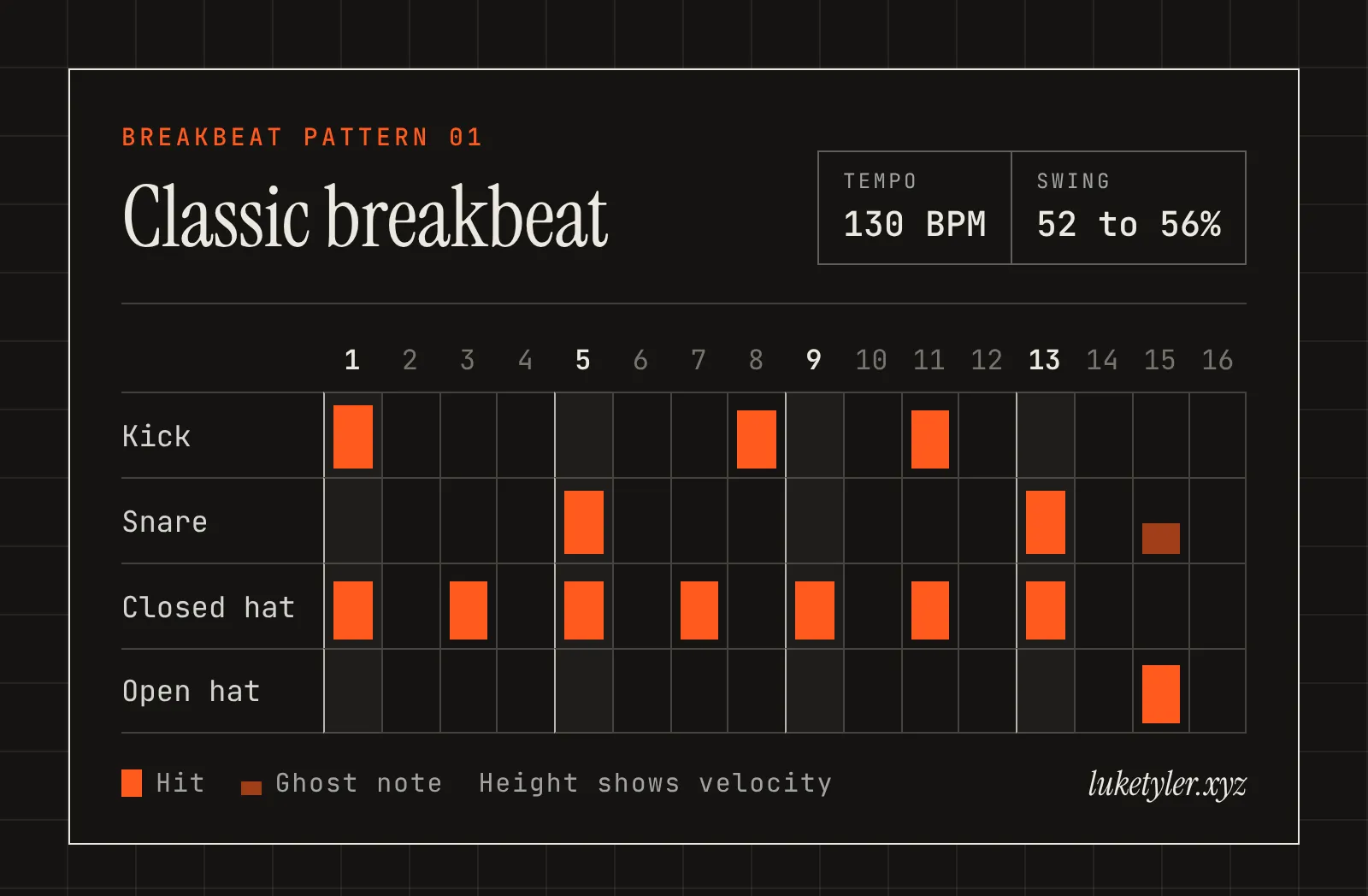
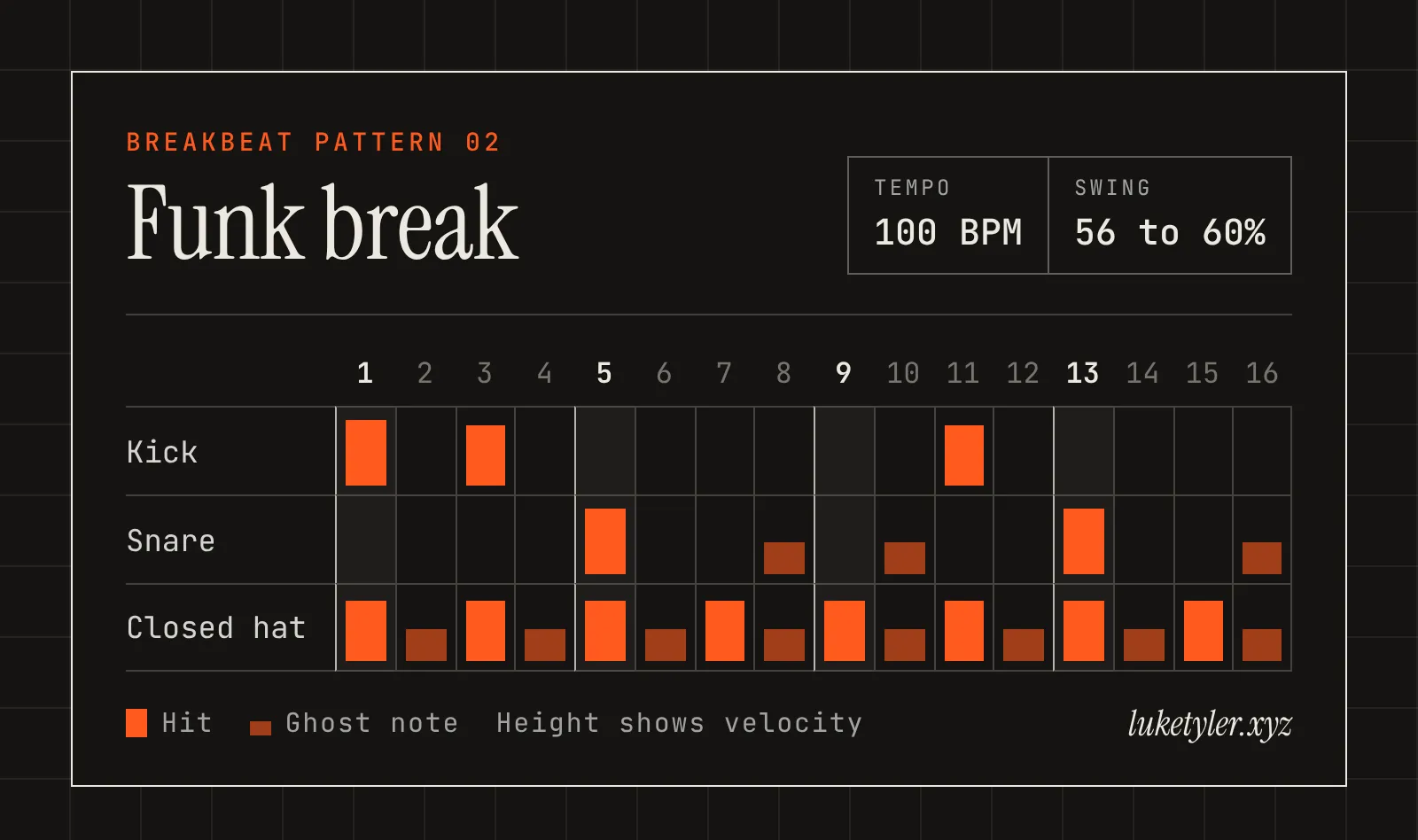
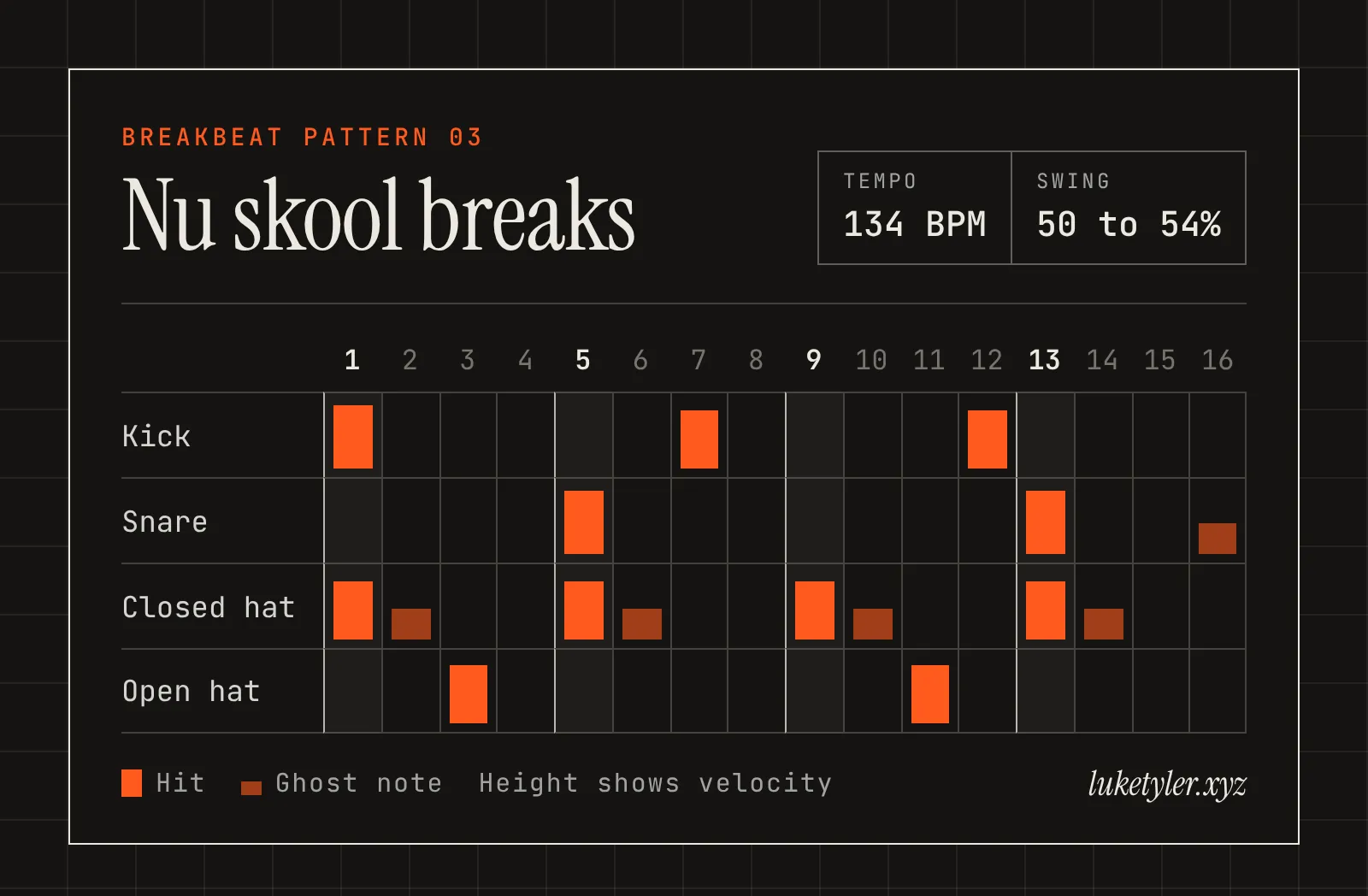
Each grid below is one bar of 16 steps, and each step is a 16th note. The shaded columns are the four beats, on steps 1, 5, 9 and 13.
- A tall orange block is a full hit, at velocity 108 to 118.
- A short, darker block is a soft ghost note, at velocity 56.
- An empty cell is a rest.
The MIDI files are written straight, with no swing baked in. They use General MIDI drum notes: kick on C1, snare on D1, clap on D#1, closed hat on F#1 and open hat on A#1.
Each file is four bars long, with a download link under its grid. Drag one onto a Drum Rack to hear it. Or drop it onto DRUM//GEN, and it'll play the pattern through your kit and grow new variations from it.
5 breakbeat drum patterns
These go from the most classic shape to more specific styles. Each one keeps the snare on two and four and moves the kick around it.
1. Classic breakbeat drum pattern
This is a good all-round breakbeat. The kick plays on 1, then on 8 and 11, which gives the second half of the bar its bounce. A ghost snare on 15 rolls into the next bar, and an open hat on the same step adds a lift.
Tempo: 125 to 135 BPM (the MIDI is at 130). Swing: 52 to 56 percent on 16ths.
Try this: move the kick on step 8 to step 7 in bar two. It's a tiny change, and it stops the loop feeling like a loop.
2. Funk break drum pattern
This is the slow, ghost-note-heavy groove that a lot of sampled breaks come from. The kick plays on 1, 3 and 11. Ghost snares on 8, 10 and 16 sit between the backbeats, and the hats play every 16th with the in-between ones soft.
Tempo: 95 to 105 BPM (the MIDI is at 100). Swing: 56 to 60 percent on 16ths.
Try this: speed it up to 170 BPM. Plenty of jungle and DnB grooves started life as slow funk breaks played much faster.
3. Nu skool breaks drum pattern
Nu skool breaks is the tougher, club-focused style that grew in the late 1990s. The kick lands on 1, 7 and 12, and the snare is big and bright on two and four. Open hats on 3 and 11 give it drive.
Tempo: 130 to 138 BPM (the MIDI is at 134). Swing: 50 to 54 percent on 16ths.
Try this: compress the drum bus hard and blend it back in under the dry drums. This style likes a lot of punch.
4. Big beat drum pattern
Big beat is slower and heavier, with a loud, roomy kit. The kick doubles on 1 and 3, then again on 9 and 12. The snare stays on two and four, with open hats on 3 and 11.
Tempo: 100 to 120 BPM (the MIDI is at 110). Swing: 52 to 56 percent on 16ths.
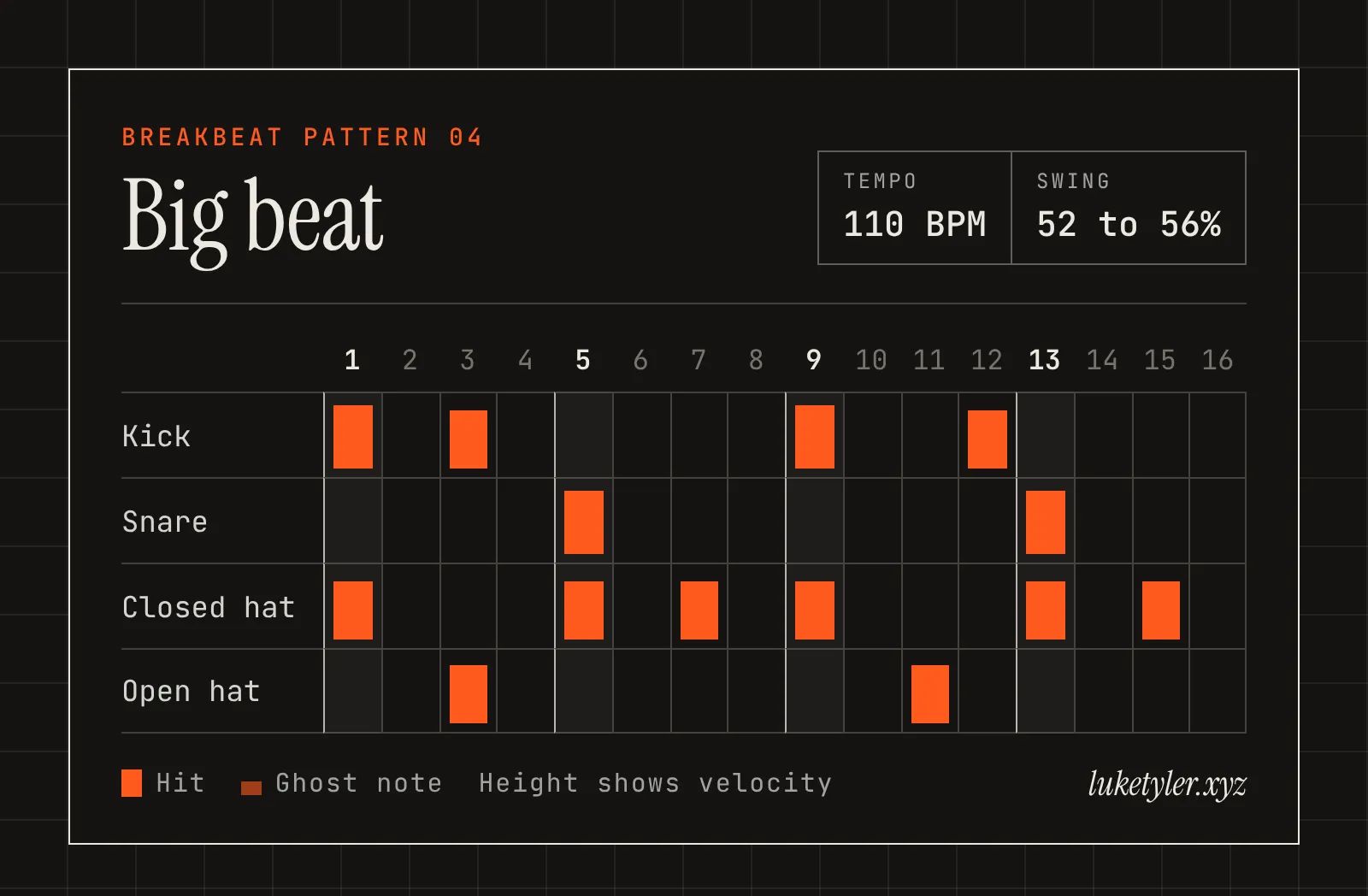
Try this: add a touch of distortion or saturation to the whole kit. Big beat drums sound best when they're a bit rough around the edges.
5. Electro breaks drum pattern
Electro breaks use drum machine sounds and a straighter feel. The kick hits 1, 4 and 11, and a clap takes the backbeat. The closed hats play every 16th, with the in-between ones soft, like a classic drum machine.
Tempo: 125 to 130 BPM (the MIDI is at 128). Swing: 50 to 52 percent on 16ths.
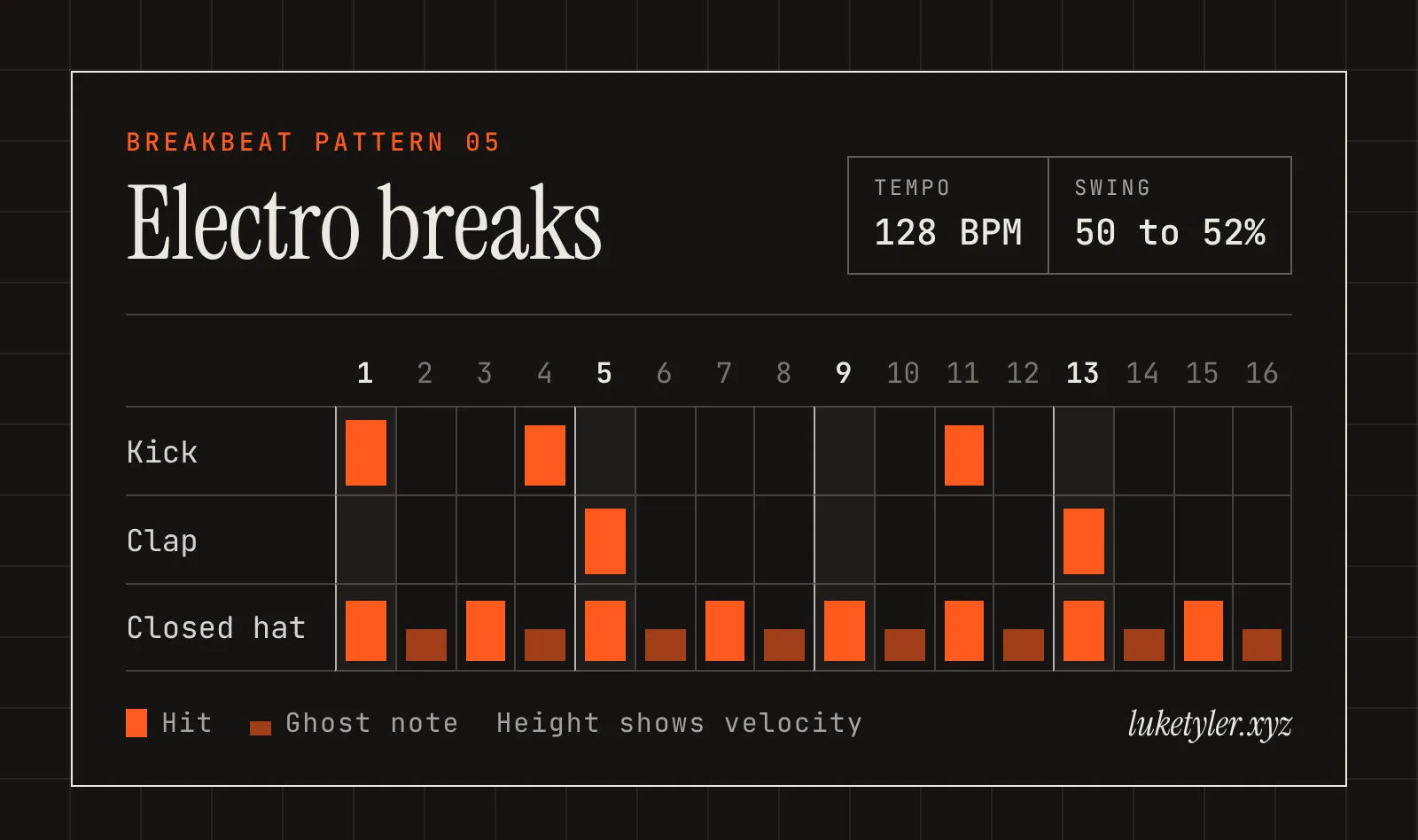
Try this: use short, tuned toms or a cowbell for a second percussion line. Electro is a good place for bleepy, synthetic sounds.
Making your breaks sound less programmed
The fix is usually velocity and timing. Real drummers never hit the same way twice, so a little movement goes a long way.
- Vary the velocity. Give the snare on beat four a little less than beat two, or the other way round.
- Nudge a few hits. Push one or two ghost notes a few milliseconds late. Don't move the main kick and snare.
- Add room sound. A short room reverb on the whole kit makes separate samples feel like one drummer.
- Layer a quiet loop. A sampled break under your programmed one, turned well down, adds air and movement.
Generate breaks with DRUM//GEN
DRUM//GEN, my Max for Live drum pattern generator, has a Breaks feel and an Electro feel built in. Pick one, hit Generate, and it writes a full 4-bar groove straight into a clip, played through your own Drum Rack.
It maps your kit for you, builds variations from the same root, and puts fills in their own clips. You can also drop one of the MIDI files from this post onto it and grow new variations from there. It's £15 in the Max for Live devices shop.
Hear breakbeat in finished tracks
To hear these ideas in context, listen to the breakbeat tracks in my publishing catalogue. Every clip is 30 seconds, and the full tracks are available to libraries and publishers.
This is one of a set of drum guides. Take these breaks up to 174 BPM with my drum and bass drum patterns, or go the other way with UK garage, house and techno drum patterns.
FAQs
What BPM is breakbeat?
Most breakbeat sits between 100 and 140 BPM. Big beat and funk breaks are often at the slower end, around 100 to 120. Nu skool breaks and electro breaks usually run from about 125 to 138.
What is the basic breakbeat drum pattern?
A snare on beats two and four, with the kick on beat one and one or two syncopated spots, such as steps 8 and 11. The hats usually play 8th notes. Everything else is decoration.
How do I chop a break in Ableton?
Right-click the audio clip and choose Slice to New MIDI Track. Ableton puts each slice on its own Drum Rack pad, with a MIDI clip that plays the break back. Move the notes to make new patterns.
Can I use famous breaks in my music?
Only if you've cleared them, or they come from a sample pack that allows it. Famous breaks come from records someone else owns. If you're unsure, program your own pattern instead.
Can I use these MIDI patterns in my releases?
Yes. Use them in anything you make, paid or free, with no credit needed. They're starting points, so change them until they sound like you.