Drum and Bass Drum Patterns: From Two-Step to Rollers
A drum and bass drum pattern runs at around 170 to 176 BPM, with a kick on beat one, a snare on beats two and four, and a second kick that skips to the "and" of beat three. That's the two-step. Almost every other DnB groove, from rollers to halftime, is built by adding to it or taking away from it.
The hard part at this tempo is getting the drums to roll without turning into a blur. These five patterns cover the main shapes, each with a step grid and a free MIDI file you can drop into Ableton or any other DAW.
What makes a drum and bass beat?
A drum and bass beat is a fast breakbeat, usually 170 to 176 BPM, built around a heavy snare on two and four. The kick moves around that snare, and the hats or ride fill in the gaps.
The two-step skeleton
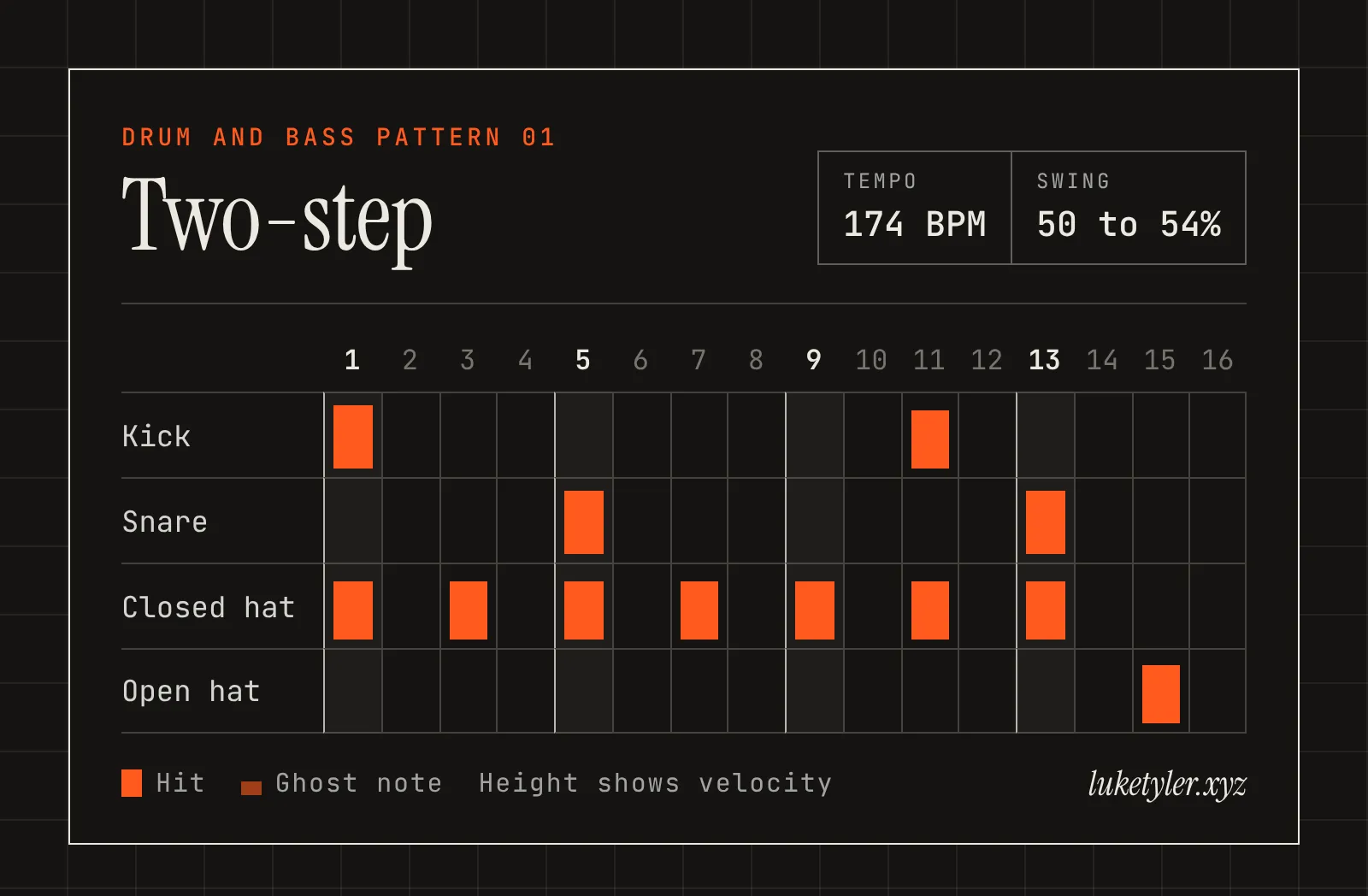
On a 16-step grid, the classic two-step puts the kick on step 1 and step 11, and the snare on steps 5 and 13. That second kick lands on the "and" of beat three, so the bar feels like it's leaning forward into the next snare. Learn this one first. Most DnB patterns are this skeleton with extra notes on top.
Why the snare matters most
At 174 BPM, the snare is what people dance to. The kick is often felt more than heard, because the bass takes up so much of the low end. So give the snare plenty of crack, and keep the kick short and tight.
Ghost notes and swing
Ghost notes are quiet snare hits between the main ones. They're what turn a stiff loop into a rolling one. DnB uses much less swing than garage or deep house. Many grooves sit close to straight, around 50 to 55 percent.
How to read the grids
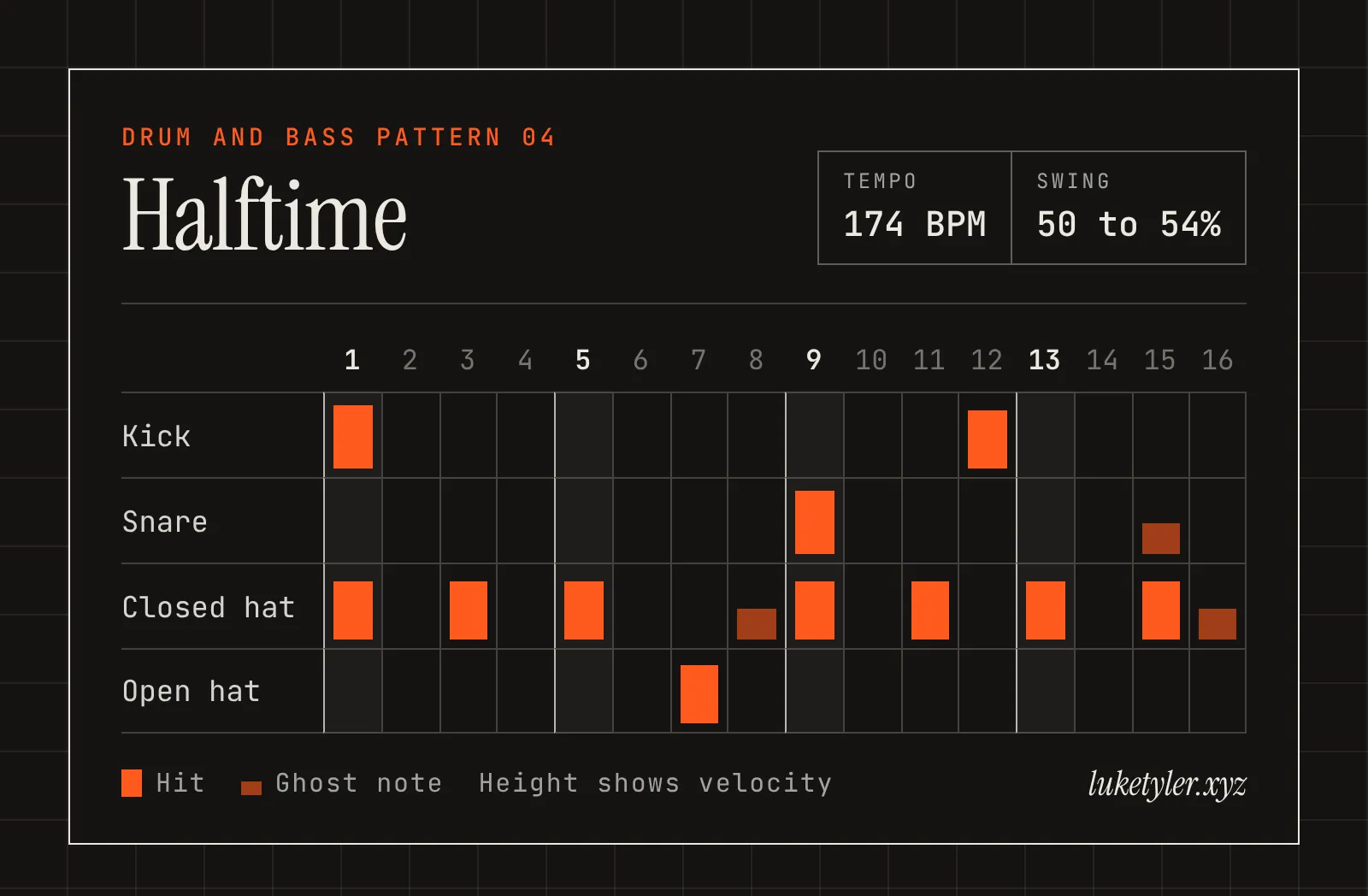
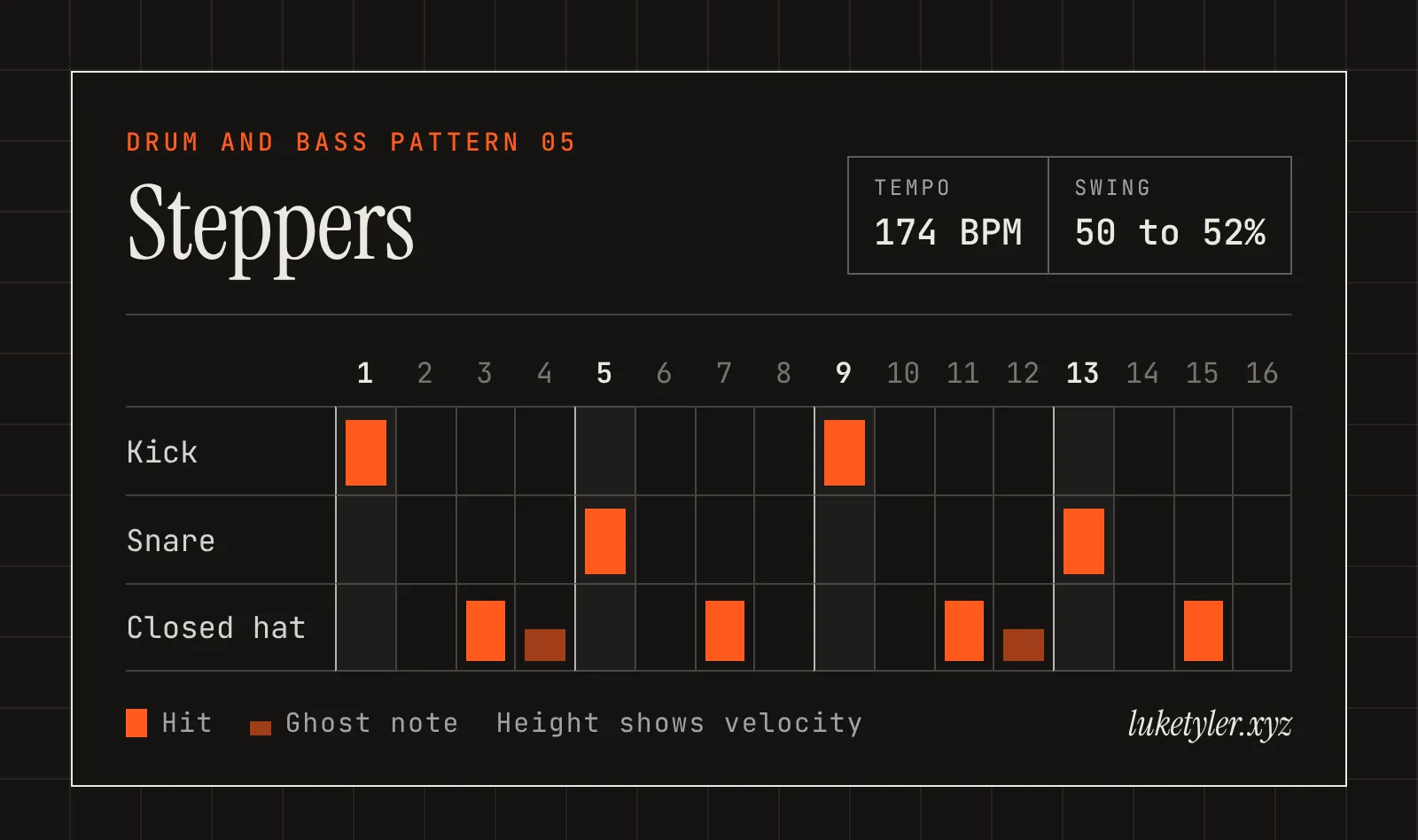
Each grid below is one bar of 16 steps, and each step is a 16th note. The shaded columns are the four beats, on steps 1, 5, 9 and 13.
- A tall orange block is a full hit, at velocity 108 to 118.
- A short, darker block is a soft ghost note, at velocity 56.
- An empty cell is a rest.
The MIDI files are written straight, with no swing baked in. They use General MIDI drum notes: kick on C1, snare on D1, closed hat on F#1, open hat on A#1 and ride on D#2. Those line up with most Drum Rack kits.
Each file is four bars long, and there's a download link under every grid. Drag one onto a Drum Rack in Ableton to hear it. If you have DRUM//GEN, drop the file onto the device instead, and it'll play the groove through your own kit and grow new variations from it.
5 drum and bass drum patterns
Start with the two-step. The rest show how far that one idea stretches, from busy rollers to the space of halftime.
1. Two-step drum pattern
This is the core drum and bass drum pattern. The kick plays on 1 and 11, and the snare sits on 5 and 13. Closed hats play on the 8th notes, and one open hat on step 15 pulls you into the next bar.
Tempo: 170 to 176 BPM (the MIDI is at 174). Swing: 50 to 54 percent on 16ths.
Try this: in bar four, drop the kick on step 11 and add a ghost snare there instead. It gives the end of the phrase a little lift.
2. Rollers drum pattern
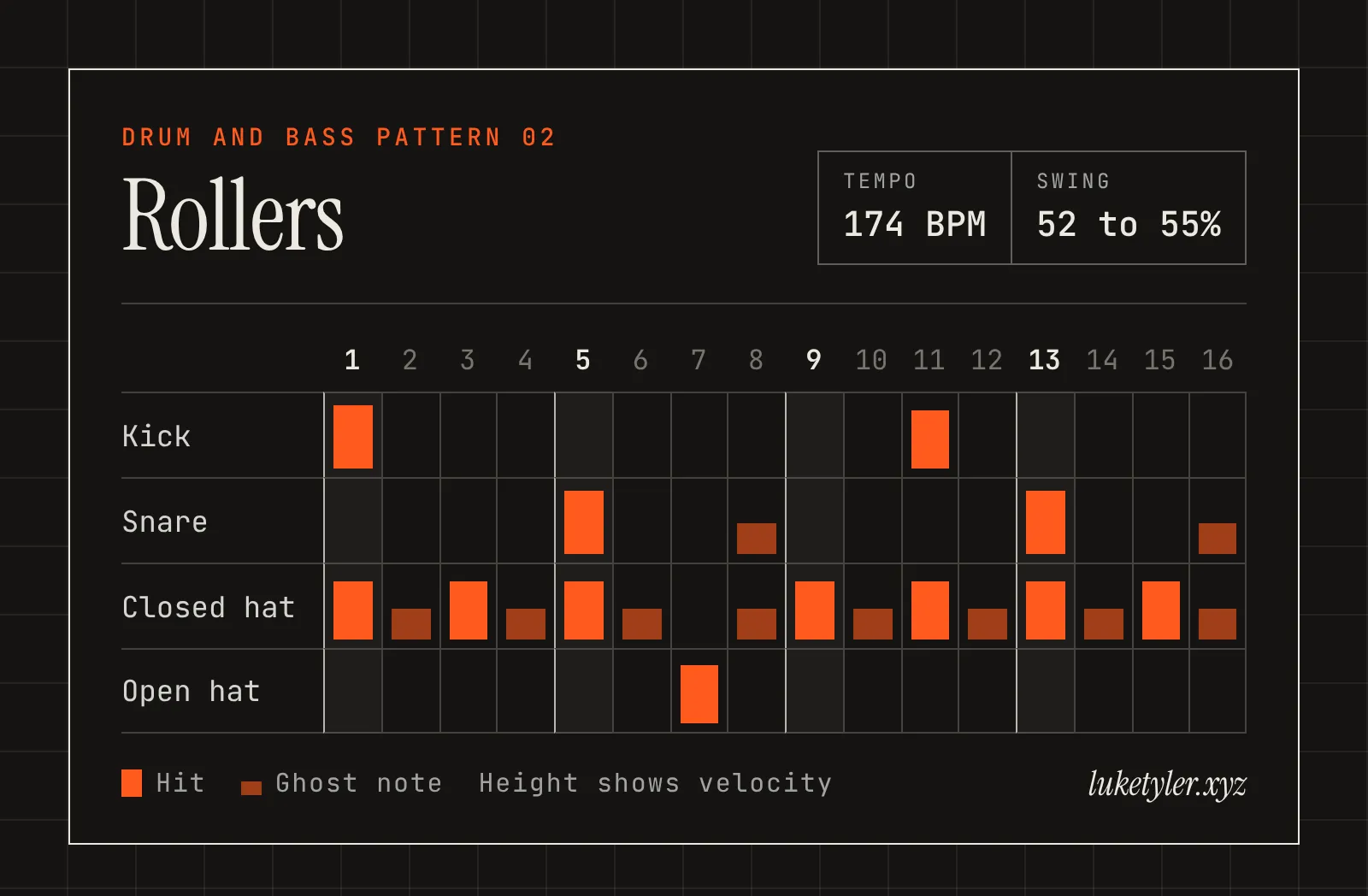
Rollers keep the two-step kick and snare, then fill every 16th with hats. The off-beat 16ths are ghost notes, so the hats shimmer instead of shouting. Two ghost snares, on steps 8 and 16, keep it rolling into each main snare.
Tempo: 172 to 175 BPM (the MIDI is at 174). Swing: 52 to 55 percent on 16ths.
Try this: run the hats through a short delay synced to 1/16 and keep it low in the mix. It thickens the roll without adding more notes.
3. Amen-style break drum pattern
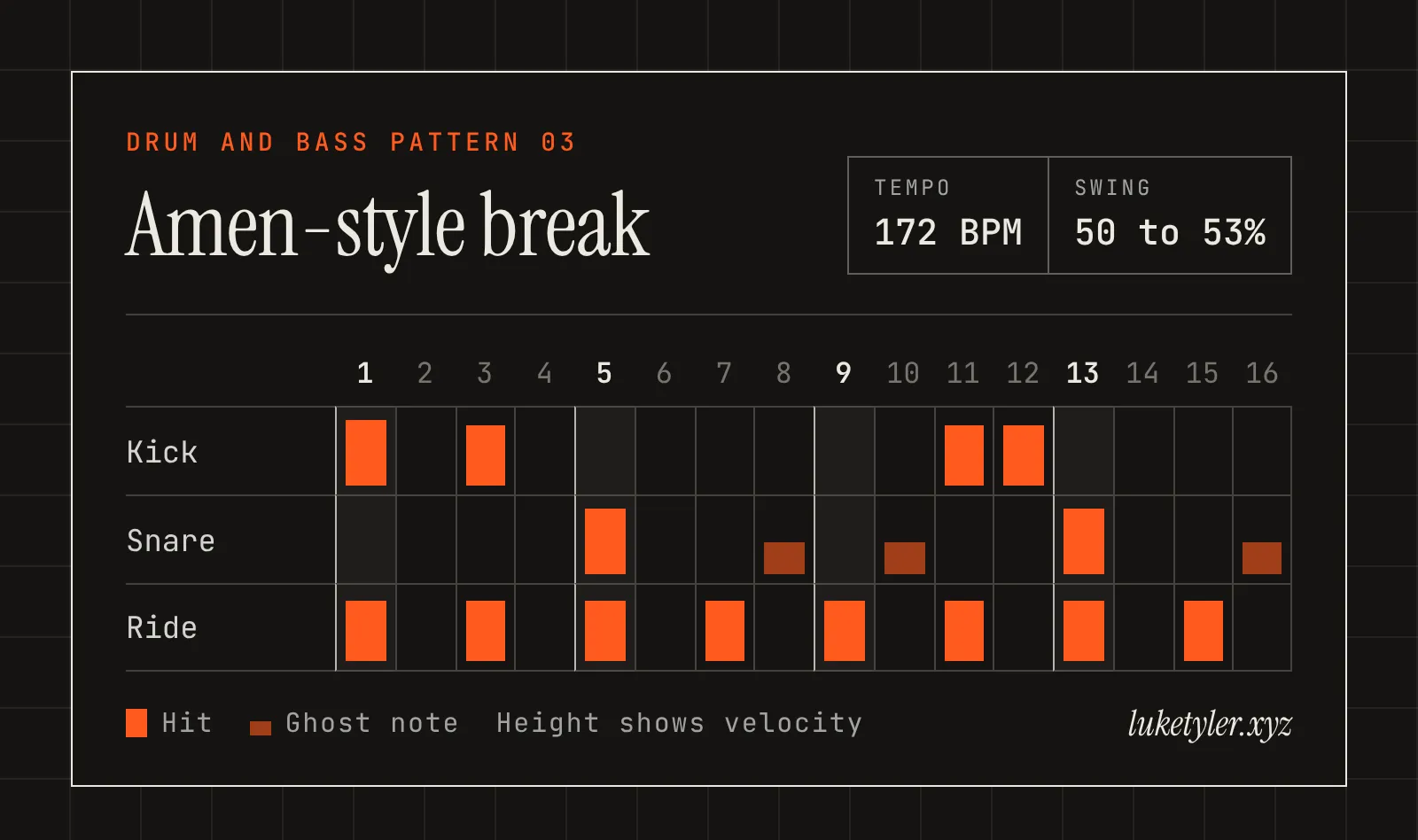
This one is programmed in the style of the classic chopped breaks that jungle and early DnB were built on. The kick doubles up on 1 and 3, then again on 11 and 12. Ghost snares on 8, 10 and 16 give it that tumbling feel, and a ride plays the 8ths on top.
Tempo: 168 to 174 BPM (the MIDI is at 172). Swing: 50 to 53 percent on 16ths.
Try this: layer this pattern quietly under a sampled break, with the kick and snare lined up. You get the character of the break and the punch of your own drums.
4. Halftime drum pattern
Halftime keeps the tempo at 174 but moves the snare to beat three, on step 9. That makes the track feel half as fast, while the hats keep the energy up. The kick plays on 1 and 12, with a ghost snare on 15 to set up the next bar.
Tempo: 170 to 176 BPM (the MIDI is at 174). Swing: 50 to 54 percent on 16ths.
Try this: use halftime for an intro or a second drop, then switch back to the two-step. The change in feel does the work of a big build.
5. Steppers drum pattern
Steppers put the kick on beat one and beat three, steps 1 and 9, with the snare on two and four. It's straighter and more marching than the two-step, which suits darker, heavier tracks. The hats stay sparse, mostly on the off-beats.
Tempo: 172 to 176 BPM (the MIDI is at 174). Swing: 50 to 52 percent on 16ths.
Try this: let the bass play on the gaps between kicks. In a steppers groove, the kick and bass work best when they take turns.
Getting the roll right at 174 BPM
Most flat DnB drums come down to velocity, sound length and too many notes. Fix those first, and the groove usually starts to move.
- Keep ghost notes quiet. If you can clearly hear a ghost snare, it's too loud. They should be felt more than heard.
- Shorten everything. At this tempo, long tails smear together. Trim the kick, and keep hats short.
- Use less swing than you think. A little goes a long way at 174. Try 52 percent and adjust by ear.
- Leave room for the bass. The bass is often the loudest thing in a DnB track. A short kick with a clean low end helps both.
- Write a 4-bar phrase. Keep bars one and three the same, and change one or two hits in bars two and four.
Generate DnB patterns with DRUM//GEN
If you'd rather start from a fresh groove, DRUM//GEN, my drum pattern generator for Ableton, has a D&B feel built in, plus a Breaks feel for jungle-style grooves. Pick one, hit Generate, and it writes a 4-bar pattern straight into a clip, with its own swing and velocity range.
It reads your Drum Rack's pad names and maps the kick, snare and hats for you. Variations grow from the same root, so your A and B sections belong together, and fills land in their own clips. It's £15 in the Max for Live devices shop.
Hear it in a finished track
Patterns only tell half the story. To hear how DnB drums sit with bass and chords, listen to the drum and bass in my publishing catalogue. The full tracks are available to libraries and publishers.
This post is part of a set. If you want the break-led side of things at a slower tempo, see my guide to breakbeat drum patterns. For four-to-the-floor, there are house drum patterns and techno drum patterns. And if you like the skip of the two-step, UK garage drum patterns is its swung cousin.
FAQs
What BPM is drum and bass?
Most drum and bass sits between 170 and 176 BPM, with 174 the most common choice today. Older jungle and DnB often ran a little slower, around 160 to 170. Halftime tracks keep the same tempo but feel half as fast.
What is a two-step in drum and bass?
It's the basic DnB groove. The kick plays on beat one and on the "and" of beat three, which is step 11 on a 16-step grid. The snare plays on beats two and four.
What is a roller in DnB?
A roller is a track with a steady, driving groove that keeps moving forward. The drums are usually a two-step with busy 16th hats and ghost snares. The aim is momentum more than big drops.
Should drum and bass drums have swing?
A little. Most DnB sits close to straight, around 50 to 55 percent on 16ths. Ghost notes and velocity do more for the groove than swing does at this tempo.
Can I use these MIDI patterns in my releases?
Yes. Use them in anything you make, paid or free, with no credit needed. They're starting points, so change them until they sound like you.