Techno and Tech House Drum Patterns
A techno drum pattern is built on a kick on every beat, at around 125 to 140 BPM, with hats on the off-beats and very little swing. The clap or rim is often sparse or missing. Techno gets its pull from repetition, small changes over time and the space between the hits.
These are five patterns that cover the main shapes, from classic and driving to dub and hypnotic, plus a rolling tech house groove from the techno side of the fence. Each one has a 16-step grid and a free MIDI file for Ableton or any other DAW.
What makes a drum pattern sound like techno?
A steady four-to-the-floor kick, off-beat hats, a fairly straight feel and plenty of repetition. Get those right, then let the sounds and the small changes do the rest.
The kick
Techno lives on the kick. It plays on every beat, steps 1, 5, 9 and 13, and it's often the loudest thing in the track. Many producers spend more time on the kick sound than on the pattern itself.
The hats and ride
The off-beat hat, on steps 3, 7, 11 and 15, gives techno its forward push. Faster styles add 16th-note hats or a ride on top. A ride with a long tail can fill a lot of space, so keep it lower in the mix than you'd expect.
Swing and repetition
Techno is usually close to straight, around 50 to 54 percent. Dub techno and groovier styles swing a little more. Because a pattern might loop for minutes, small changes matter: a hat that opens up, a rim that moves, a filter that slowly sweeps.
Techno or tech house?
Tech house sits closer to house. It's slower, usually 124 to 128 BPM, with more swing and more percussion. Techno is faster, darker and straighter. My guide to house drum patterns covers tech house from the house side. The last pattern here comes at it from the techno side.
How to read the grids
Each grid below is one bar of 16 steps, and each step is a 16th note. The shaded columns are the four beats, on steps 1, 5, 9 and 13.
- A tall orange block is a full hit, at velocity 108 to 118.
- A short, darker block is a soft ghost note, at velocity 56.
- An empty cell is a rest.
The MIDI files are written straight, with no swing baked in. They use General MIDI drum notes: kick on C1, rim on C#1, clap on D#1, closed hat on F#1, open hat on A#1 and ride on D#2.
Each file is four bars long, with a download link under its grid. Drag one onto a Drum Rack to hear it. If you have DRUM//GEN, drop it onto the device, and it'll play the pattern through your kit and build fresh variations from it.
5 techno and tech house drum patterns
Start with the classic pattern, then work down. Each one changes only a few things, which is very techno.
1. Classic techno drum pattern
This is the basic techno drum pattern. Four kicks, a clap on two and four, and an open hat on every off-beat. Quiet closed hats on the even steps add a soft 16th-note pulse under it all.
Tempo: 128 to 132 BPM (the MIDI is at 130). Swing: 50 to 54 percent on 16ths.
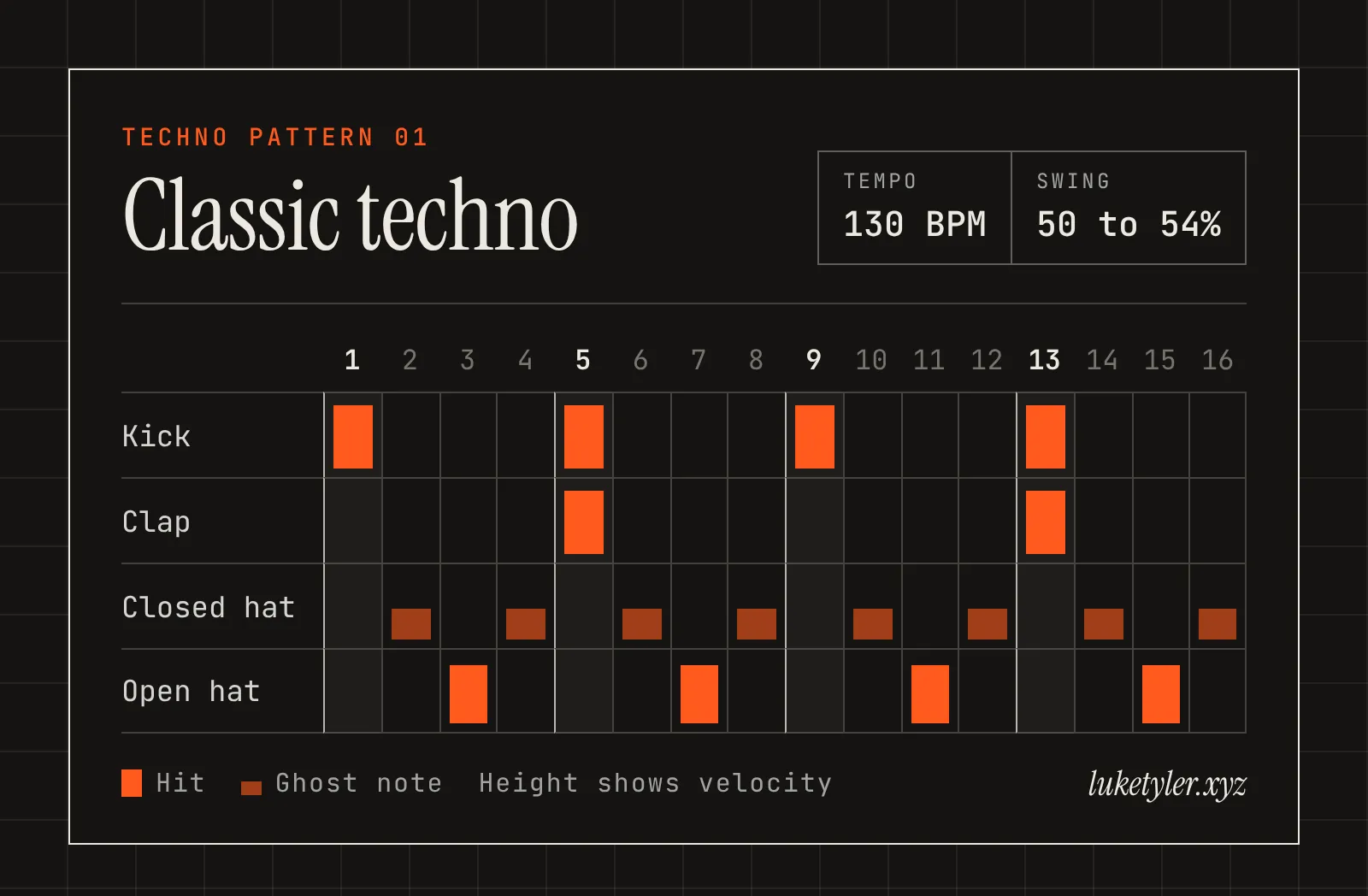
Try this: automate the open hat's decay over 32 bars, from very short to quite long. The groove opens up without a single note changing.
2. Driving techno drum pattern
This is the faster, peak-time shape. The closed hats run every 16th, with the louder ones on the in-between 16ths, and a ride takes the off-beats. The clap stays on two and four.
Tempo: 135 to 140 BPM (the MIDI is at 138). Swing: 50 to 52 percent on 16ths.
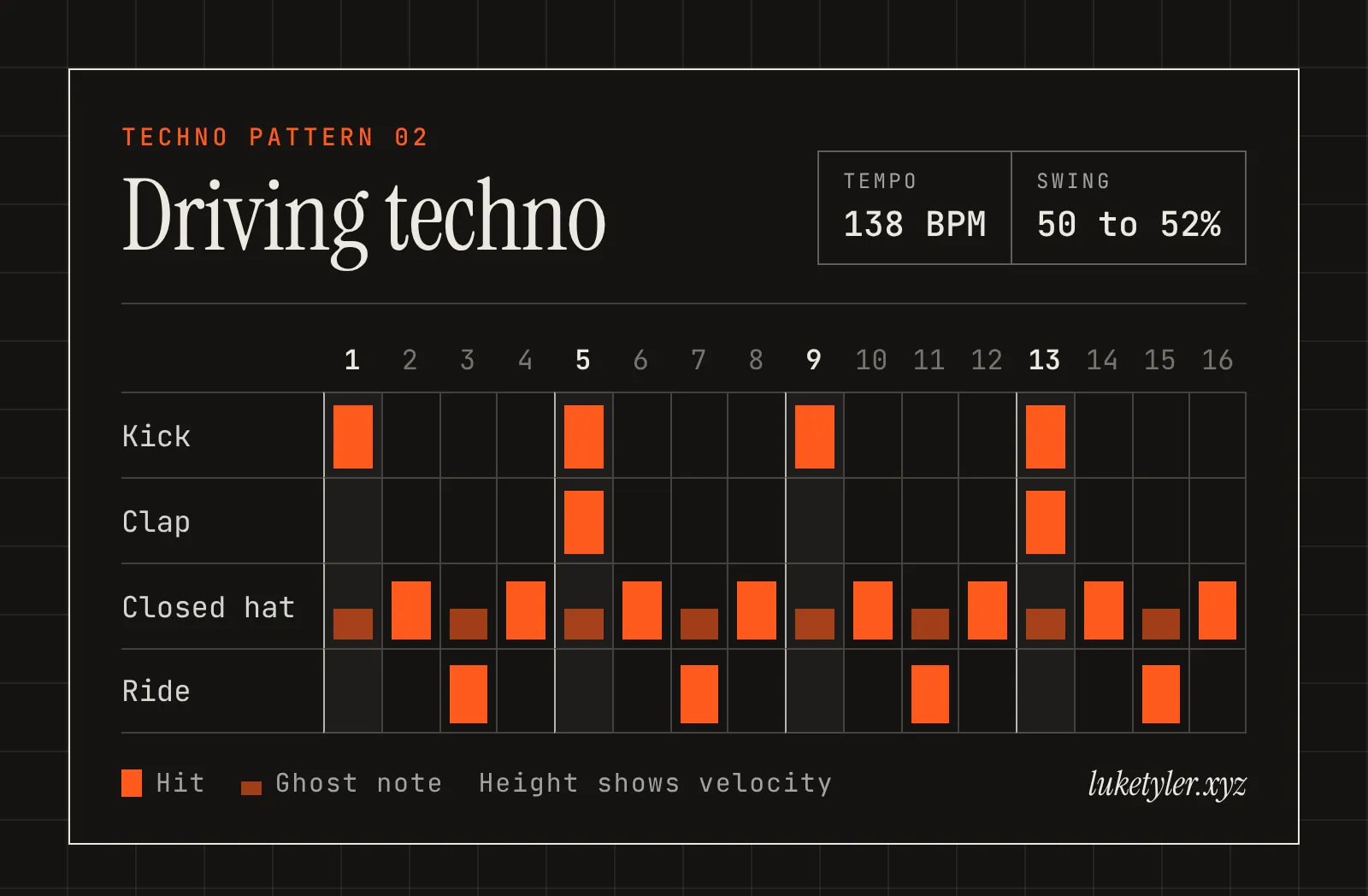
Try this: high-pass the ride quite hard and pan it slightly off-centre. It keeps the top end busy without crowding the hats.
3. Hypnotic techno drum pattern
There's no clap here. A rim plays a syncopated line on steps 4 and 11, with a ghost on 14, and that line becomes the hook. The hats stay on the off-beats with two soft extras.
Tempo: 126 to 130 BPM (the MIDI is at 128). Swing: 52 to 56 percent on 16ths.
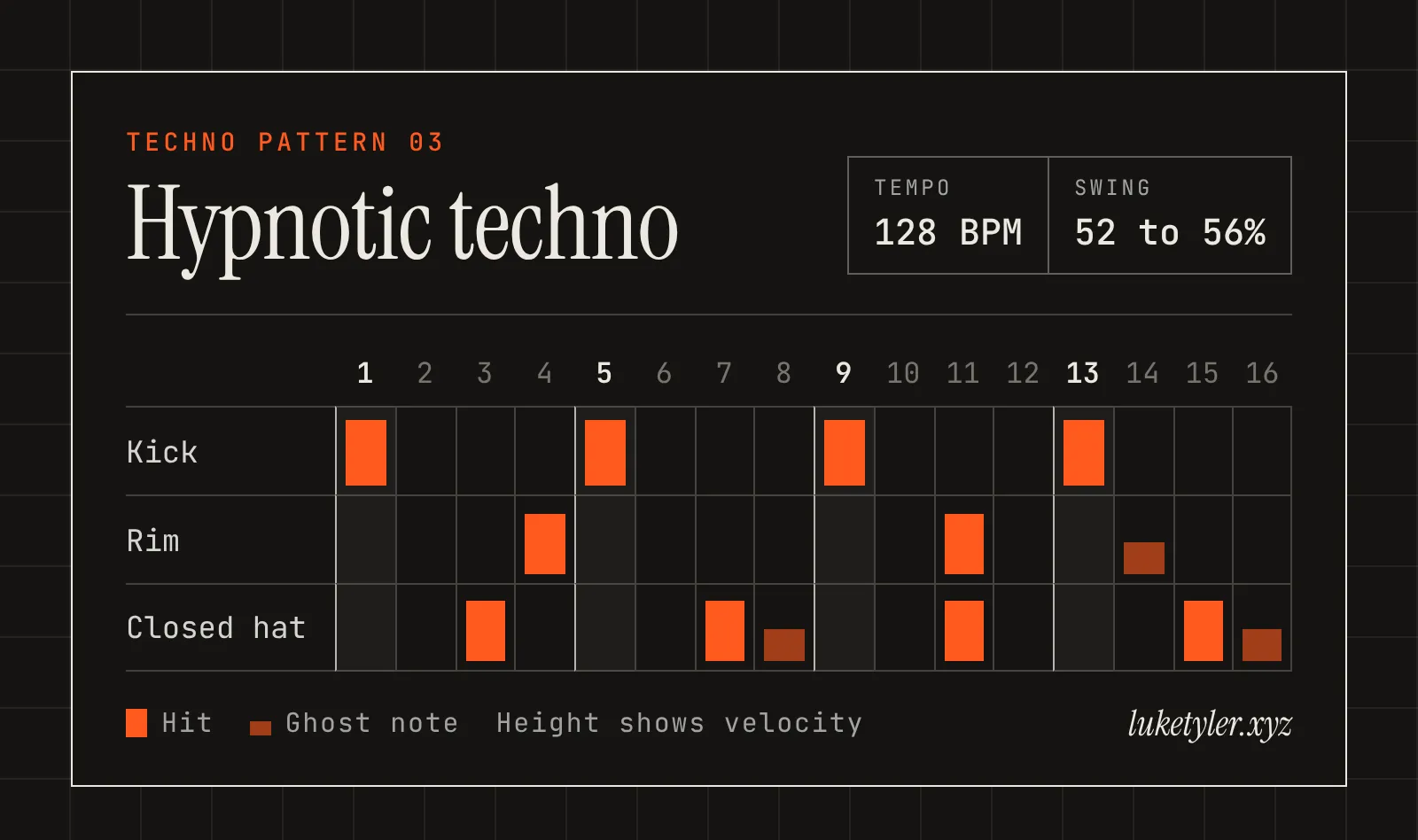
Try this: send the rim to a dotted 1/8 delay with plenty of feedback, then filter the delay. The echoes turn one rim line into a whole percussion part.
4. Dub techno drum pattern
Dub techno is slower and softer. A rim takes the place of the clap on two and four, with a ghost on 16. The closed hats are gentle, and an open hat on step 15 leads into the next bar.
Tempo: 118 to 124 BPM (the MIDI is at 122). Swing: 54 to 58 percent on 16ths.
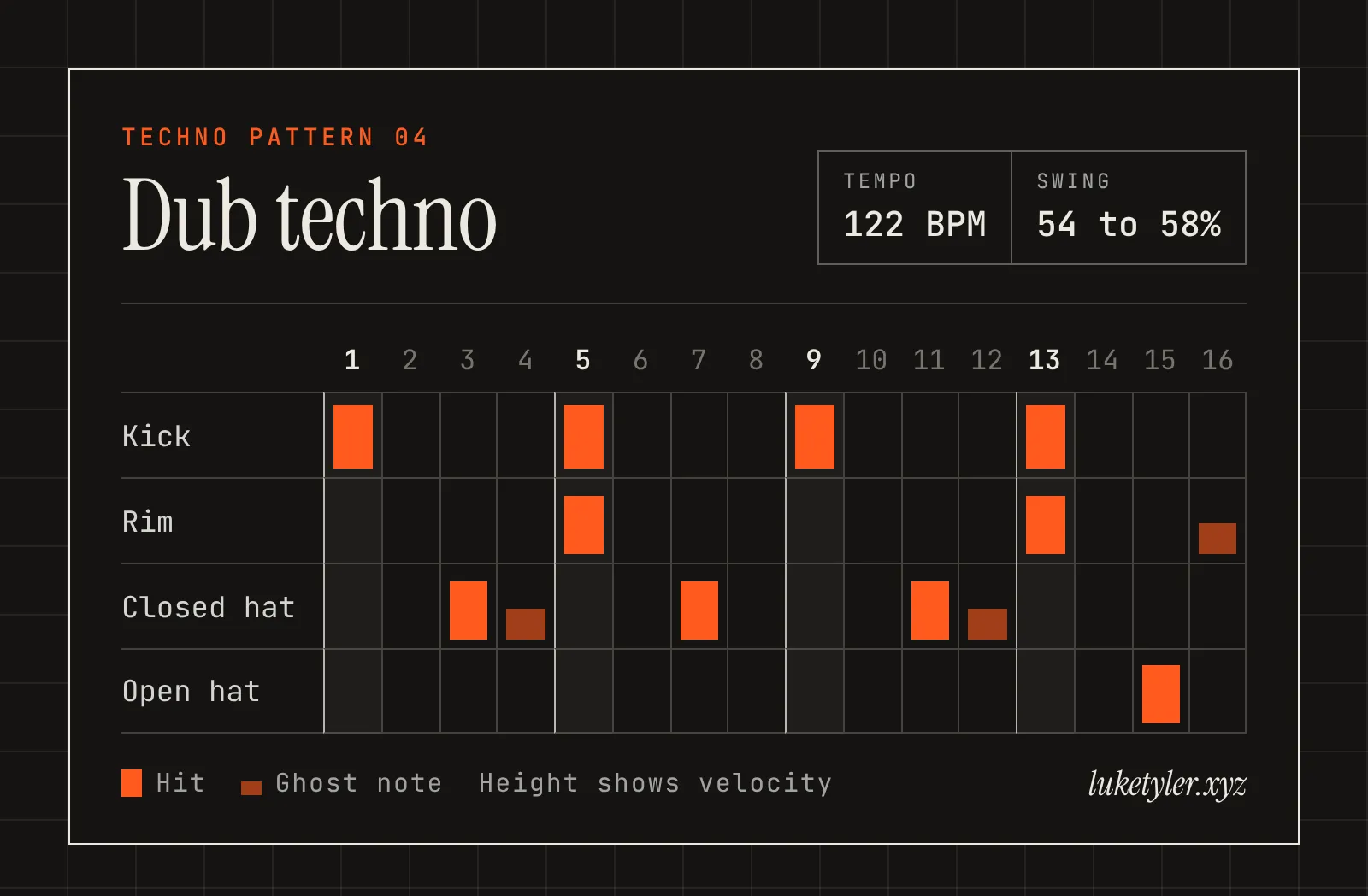
Try this: put the rim and hats through a long, dark reverb and a tape-style delay. In dub techno, the space around the drums matters as much as the drums.
5. Rolling tech house drum pattern
This one leans into tech house, but keeps a techno feel. Four kicks and a clap on two and four, with open hats on every off-beat. A rim plays on steps 4 and 12, with ghosts on 8 and 15, so the groove rolls forward.
Tempo: 124 to 128 BPM (the MIDI is at 126). Swing: 54 to 57 percent on 16ths.
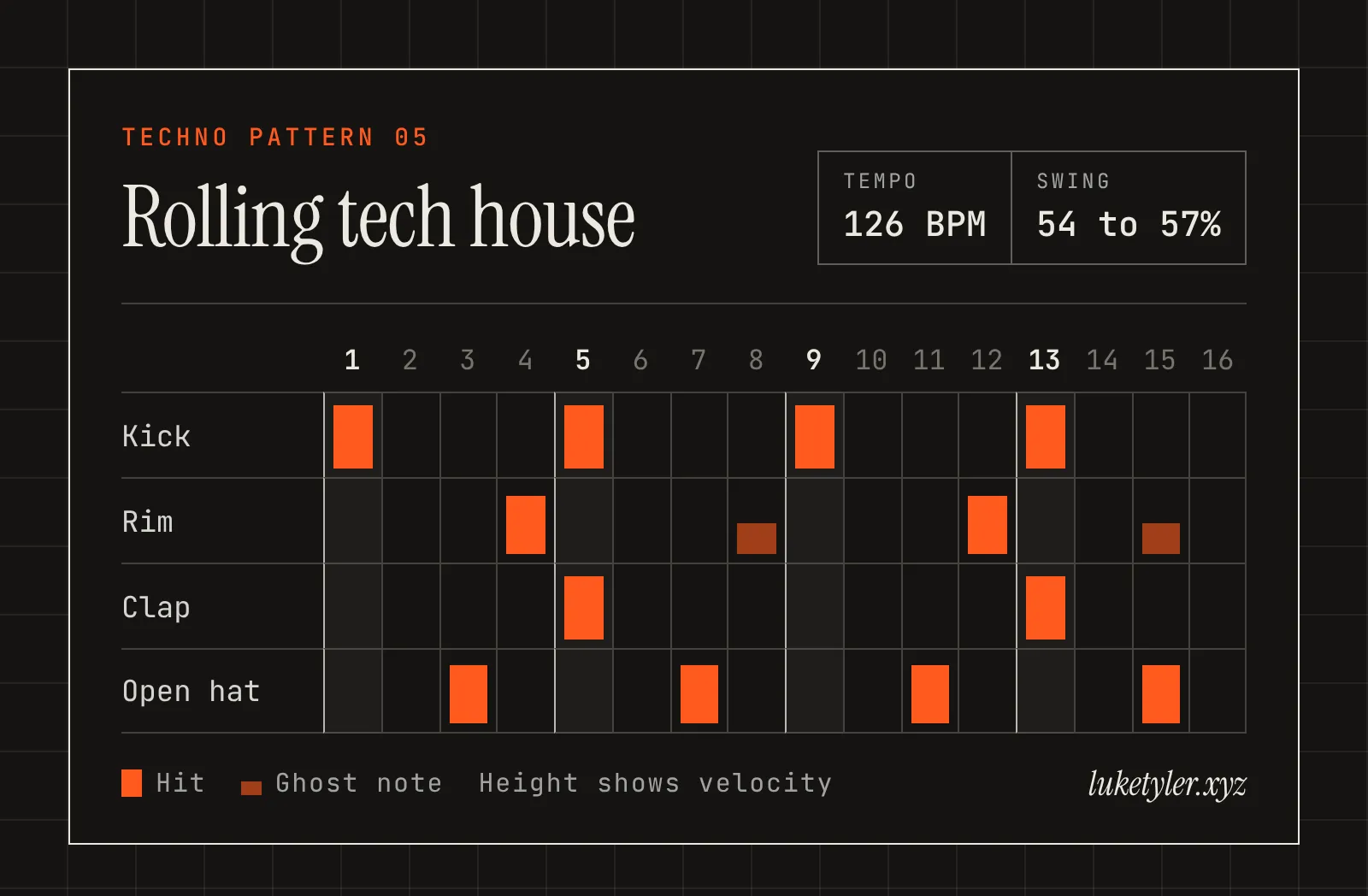
Try this: swap the rim for a short conga or a clave. Tech house often gets its bounce from percussion more than from the hats.
Keeping a techno loop interesting
Change the sound more than the notes. In techno, a pattern can stay the same for minutes while the track keeps moving.
- Automate decay and tone. Hats that open, a kick that gets a touch brighter, a rim that gets drier.
- Add and remove layers. Bring a ride in for 16 bars, then take it out again.
- Use probability. In Ableton Live 11 and later, you can set a chance for single notes. A ghost hat at 50 percent makes each bar a little different.
- Change one hit every 8 or 16 bars. Move a rim or drop a kick. Small changes keep the dance floor listening.
Generate techno patterns with DRUM//GEN
DRUM//GEN, my drum pattern generator for Ableton, has a 4x4 feel that suits techno and tech house, plus a Spacious feel for sparser grooves. Pick one, hit Generate, and it writes a 4-bar pattern straight into a clip.
It maps your Drum Rack for you, builds variations from the same root, and puts fills in their own clips. It's £15 in the Max for Live devices shop, and my guide to the best Max for Live devices has more tools for this kind of work.
Hear techno in finished tracks
To hear these patterns with bass, synths and arrangement around them, listen to the techno tracks in my publishing catalogue. The full tracks are available to libraries and publishers.
This post is part of a set of drum pattern guides. For more four-to-the-floor, see house drum patterns. For broken grooves, try breakbeat drum patterns, UK garage or drum and bass drum patterns.
FAQs
What BPM is techno?
Most techno sits between 125 and 140 BPM. Dub techno and deeper styles can drop to around 118 to 124. Harder, peak-time techno often runs at 135 to 150.
What is the basic techno drum pattern?
A kick on every beat, an open hat on every off-beat, and a clap or rim on two and four. On a 16-step grid, that's kicks on 1, 5, 9 and 13, and hats on 3, 7, 11 and 15.
What is the difference between techno and tech house drums?
Tech house drums are slower, more swung and full of percussion. Techno drums are faster, straighter and more stripped back. Both keep the kick on every beat.
Does techno use swing?
Only a little. Most techno sits between 50 and 54 percent on 16ths. Dub techno and tech house often swing more, around 54 to 58 percent.
Can I use these MIDI patterns in my releases?
Yes. Use them in anything you make, paid or free, with no credit needed. They're starting points, so change them until they sound like you.